Showing posts with label bermudagrass. Show all posts

Thursday, May 1, 2014

Return of the Fungi!

Things have been relatively quiet here at the NC State Turf Diagnostics Lab with regards to disease samples, however that has changed in the past couple of weeks now that warm-season turfgrasses are starting to fully wake up from their winter nap. So, without boring you to death with blah blah this and blah blah that ... here's the rundown.

Warm-Season Turf (Bermuda/Zoysia/Centipede)

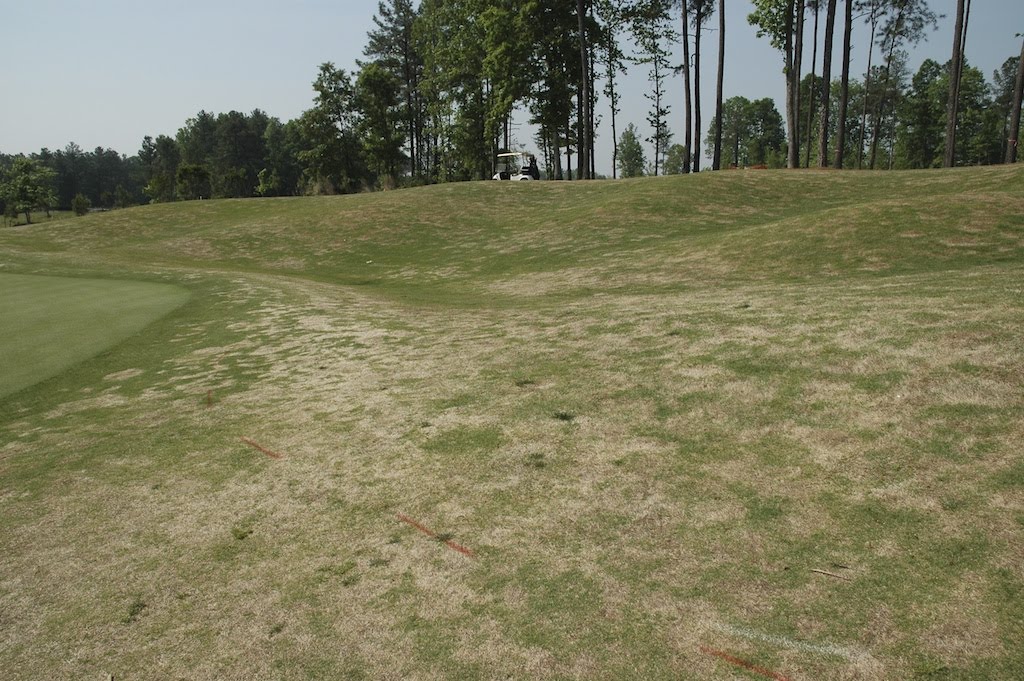
Many samples have been submitted both digitally and physically to the clinic over the past few weeks that have shown winter damage. The majority of these samples were taken from shady, wet, and/or north facing slopes. These are typical areas we expect to see this type of damage on warm-season turfgrasses. In most cases, it appears that green up has been delayed and no complete turf losses have been reported. The exception to that has been centipedegrass. We have seen some centipede lawns that we can't find any disease, insect, nematode, soil problem, etc. where winter kill is strongly suspected. This is all unfolding as I type this, so we may see cases of other warm season turfs with winter kill as they continue to fully green up across the state. For more information about winter injury in North Carolina, please read Dr. Grady Miller's recent post by clicking here.

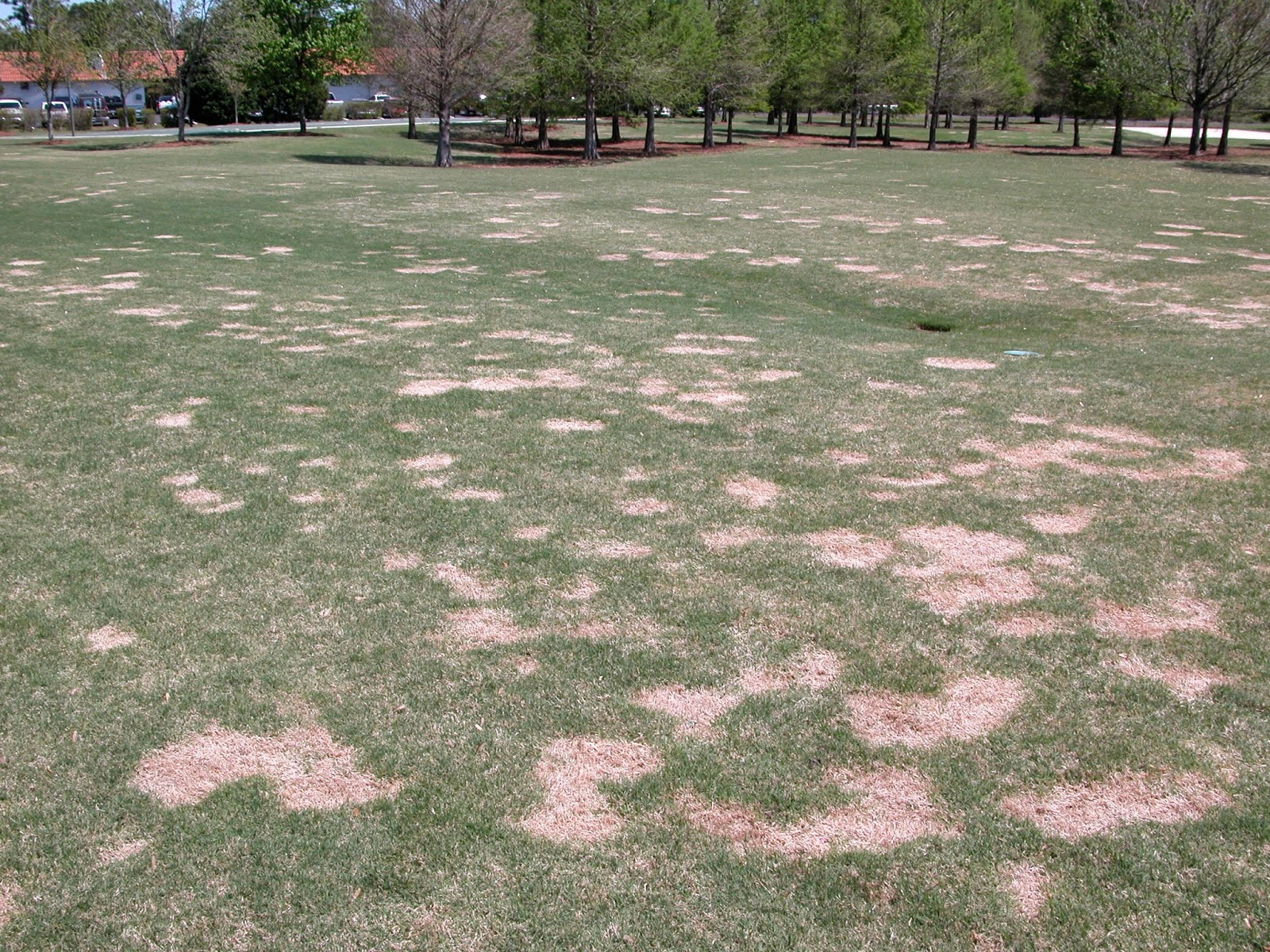
From a disease standpoint, the most common diagnosis in the past week or so has been spring dead spot on bermudagrass. This has been documented on common, hybrid, and ultradwarf types. Given the fact that spring dead spot is highly correlated with cold injury, it is no surprise that there is a lot of spring dead spot damage out there this year in North Carolina. There is nothing you can do from a fungicide standpoint at this time to recover from this disease because the damage was done last fall. For more information about spring dead spot, please click here.

Spring dead spot symptoms on ultradwarf bermudagrass
Spring dead spot symptoms on hybrid bermudagrass
Typical winter kill symptoms on warm season turf


Cool-Season Turf (Bentgrass & Ryegrass)

As expected, we haven't seen many cool-season turf samples in the past few weeks since they are able to withstand the ravages of fungi for the most part in the spring and fall.

One exception has been red leaf spot, caused by the fungus Drechslera erythrospila, on creeping bentgrass putting greens. This is a disease we have observed over the past several years. For the most part, it has been fairly random and isolated, however we are starting to see more and more of this disease for whatever reason. If you think you have red leaf spot, now is the time to treat. None of the samples that have come into the clinic are producing spores yet. This tells us that while the fungus is waking up and starting to infect via mycelium spread, it hasn't reached it's full potential to produce abundant spores. Once spores are produced, the damage will be more widespread and rapid. For more information about red leaf spot, click here.

Red leaf spot symptoms on a creeping bentgrass putting green

Finally, we have observed some dollar spot damage on perennial ryegrass in over seeded situations. Recent weather patterns have been favorable for this fungus to start coming out and eating away at our precious stands of perfect turf, so beware! If you haven't started your preventative dollar spot programs, now's the time ... especially on high value turf like creeping bentgrass. For more information about dollar spot, click here.

Dollar spot symptoms on perennial ryegrass

Wednesday, January 22, 2014

Cream Leaf What?

Cream leaf what? That's the exact response I've heard from superintendents over the past several weeks when I tell them their ultradwarf bermuda putting greens have a disease known as cream leaf blight. To answer your first question, cream leaf blight is not a new pathogen to turfgrass. It has been documented on creeping bentgrass and tall fescue. As more ultradwarf bermudagrass replaces creeping bentgrass for putting surfaces here in North Carolina, we will likely observe more new diseases. This disease has been diagnosed on both 'Champion' and 'Mini Verde' and we are in the process of complete confirmation of the causal fungus via DNA analysis.


Typical white patch symptom observed on ultradwarfs
in December/January in North Carolina

Cream leaf blight is caused by the same pathogen that causes pink patch, Limonomyces roseipellis. Pink patch is often found in close association with red thread, which is caused by the fungus Laetisaria fuciformis. Pink patch and cream leaf blight vary slightly in their morphological features, which we are able to detect under the microscope. For those of you who are plant pathology geeks, pink patch produces clamp connections and cream leaf blight does not. Otherwise, from what we've observed, the two appear identical in the field and we will most likely refer to it as cream leaf blight since that seems to match the stand symptoms the best. One unique characteristic is the mycelium will twist into "rope" like structures, as seen below.

Mycelium twisting into "ropes" for both cream leaf blight and pink patch (25x)

Close up of cream leaf blight hyphae twisting into a "rope" (200x)

While we don't know much about cream leaf blight on bermudagrass yet, we have only observed cosmetic damage and nothing that leads to turf loss or significant reduction in playability. We have been recommending fungicide applications of products like 26GT, ProStar, Heritage, Insignia, or Disarm since they have been proven performers with pink patch/red thread complexes.

If you are observing this type of symptom at your course and have questions, feel free to contact us!

Monday, October 21, 2013

Bermudagrass Greens Looking Bad?


Recent weather patterns of cool/cloudy/rainy weather across much of North Carolina have been perfect for foliar diseases such as Bipolaris leaf spot and Pythium blight on bermudagrass putting greens.

Bipolaris Leaf Spot Symptoms on Ultradwarf Bermudagrass

We have received many samples in the past week at the NC State Turf Diagnostics Lab that were devastated by the fungus Bipolaris cynodontis. Bipolaris leaf spot is most severe on turf that is growing slowly due to adverse weather conditions or improper management practices.  Shaded areas with little or no air movement result in weak turf and extended periods of leaf wetness that favor disease development. Deficient or excessive nitrogen, excessive thatch, extended periods of leaf wetness, and low mowing heights are factors that encourage the development of leaf spot diseases. The fungus is easily spread by mowers, wind, and/or rain.

For more information about Bipolaris leaf spot, including control recommendations, click here.


Ultradwarf Bermudagrass Devastated by Pythium Blight
(note mycelium on leading edge)

We have also diagnosed many bermudagrass samples this week with Pythium blight in conjunction with leaf spot or acting alone. The symptoms are a rapid foliar blight that initially has a purple coloration but then fades to tan. Spreading by mowers or in drainage patterns usually occurs as well. 

Pythium blight in October? Yes, you read it correctly, it is Pythium blight in October. There are a lot of Pythium species that can infect grasses. Most people are familiar with P. aphanidermatum that causes Pythium blight on the cool season grasses during hot summer weather. However, there are other Pythium species that grow during cool or cold weather. We don't know what species is causing this outbreak yet, but obviously it grows well during cool weather and has a competitive advantage over the bermudagrass under these conditions.

Fungicide treatments may not always be necessary to control Pythium blight on bermudagrass, as dry and sunny weather usually put a stop to it very quickly. However, if the forecast is calling for extended periods of wet and cloudy weather, an application might be a good idea. Any strong Pythium fungicide should do a good job.

Wednesday, October 2, 2013

What's Happening Now?


RECENT CREEPING BENTGRASS PROBLEMS

Over the past several weeks, we have received many creeping bentgrass putting green samples.  In every case, samples were submitted to check for a disease and in EACH case absolutely no pathogen activity was discovered.  Therefore, our diagnosis was "a disease was not responsible for the damage".  The common thread has been the combination of core aerification and topdressing with the unusually arid weather for this time of year. When the putting surfaces are opened up after aerification, they are more susceptible to drought stress, especially if the humidity is very low. This effect is exacerbated in areas that are already stressed such as clean up laps, heavy on/off traffic spots, etc.

This is a fine example of why receiving a diagnosis of "no disease" is just as important as receiving a diagnosis of an actual disease. Because symptoms developed during excellent growing conditions for creeping bentgrass, a safe assumption is a disease is responsible for the damage.  Yet, in this case an accurate diagnosis can save time and money by preventing unwarranted fungicide applications.  If you don't agree, feel free to make a fungicide application for drought stress and see what happens.

Typical Stress Symptoms Observed with Recent Samples


TREAT FOR LARGE PATCH NOW!

With soil temperatures starting to approach 70°F across portions of NC, now is the time to treat for large patch.

Average Daily Soil Temperatures as of 10/01/13 via NC State Climate Office

Large patch, which is caused by the fungus Rhizoctonia solani, is a common disease of centipedegrass, St. Augustinegrass, zoysiagrass, and bermudagrass grown for lawns, landscapes, golf turf, and athletic fields. Centipedegrass and St. Augustinegrass are particularly susceptible to severe damage from this disease.

Symptoms of large patch appear in roughly circular patches from 2 feet up to 10 feet or more in diameter. The affected turf will initially be orange, yellow, or reddish-brown in color but will then turn tan and collapse to the ground. The disease can spread rapidly to encompass large areas of turf, and distinct circular patches may not be obvious in these cases.

Fungicides are available for large patch control, but they must be applied preventatively for best results. The first application should be made in the late summer or early fall when average daily soil temperatures are 70°F or below.

One fungicide application will control minor cases of large patch, but two to three applications on a 4 to 6 week interval may be needed to control severe cases. Fungicides are not very effective once the symptoms of large patch appear. Curative applications will help to reduce further spread of the disease, but the affected turf will be very slow to recover.

For more information about Large Patch, including images and specific control recommendations, click here.


TREAT FOR SPRING DEAD SPOT NOW

So, your first question may be "Why on Earth are you telling me to apply fungicides for a spring disease in the fall and for something that will not show up for another 6-7 months?!"  The answer is simple.  The causal fungus, Ophiosphaerella spp., is active RIGHT NOW and you can bet it's infecting your bermuda and zoysia grass plants as I type this blog.  We know through years of research that fungicides are most effective when the soil temperatures are between  60 - 80°F in the fall of the year.

Choosing the right fungicide and applying at the right time will not result in acceptable levels of control if you do not apply them correctly.  Spring dead spot infects below ground plant parts.  With that being said, you must either water-in your fungicide applications IMMEDIATELY  with 1/4" of irrigation or apply with a carrier volume of 5 gal/water/1,000 sq. ft.  You need to be running your irrigation the moment the applicator is out of the way.  Do not wait until the following evening or night with your routine irrigation schedule or else you may be severely disappointed come next spring when these grasses green back up.

Just recently we have made some fantastic discoveries with fertilizers in regards to controlling this disease without having to use fungicides at all!  To learn more about this, please click here.

To learn much more about spring dead spot, including control recommendations, please click here.


Wednesday, May 8, 2013

Guess What? Pythium LOVES Water!

If you've learned nothing else about turfgrass diseases, fungi love water and while not technically a fungus, the oomycete Pythium absolutely adores water. Now, you're sitting there thinking "boy, it sure has been wet lately across much of North Carolina, especially in western NC, and instead of reading this blog post, I should be firing up my sprayer and putting out something to prevent Pythium diseases." Well, if that's not the thought you had ... you better switch gears and make it happen.

Rainfall Estimates for Last 30 Days

For those of you managing bermudagrass putting greens or if you're trying to grow in a freshly seeded stand of anything, you better be on the look out for Pythium blight. We have diagnosed Pythium blight on 'Champion', 'Mini Verde', and 'Tifeagle' bermudagrass putting greens over the past couple of weeks. They are not bullet proof folks! We've also seen a lot of yellow patch on the ultradwarfs, but we'll save that for another day.

For those of you managing creeping bentgrass putting greens, you better be starting up your Pythium root rot prevention program. Two of the biggest misconceptions associated with Pythium and creeping bentgrass is that Pythium blight is common on putting green heights and Pythium root rot only occurs during the hot days of summer. Both are false. We rarely see Pythium blight on creeping bentgrass at putting green heights, especially if it's a well established mature stand. We have diagnosed Pythium root rot on creeping bentgrass putting greens in North Carolina in every month except the winter time.

For more information about Pythium blight and root rot, including control recommendations, visit the links below.

Pythium Blight

Pythium Root Rot


Friday, April 19, 2013

It's Back! Large Patch that is ...


You know it's officially spring in North Carolina when there are giant patches of brown grass in bermudagrass, centipedegrass, St. Augustinegrass, and zoysiagrass. These giant patches of brown grass are better known as large patch, caused by the fungus Rhizoctonia solani, and if you've ever had an outbreak of this disease, you now know why the disease was coined large patch.

What you may not know however, is what your control options are this time of year. You shouldn't worry too much if you have this disease on bermudagrass. Bermudagrass tends to grow out of the damage once the temperatures are consistently warmer and the daylight longer.

Large Patch Symptoms on St. Augustinegrass
As for our other warm-season friends, damage tends to be most severe on centipedegrass and recovery may take all summer in extreme cases. Unfortunately, there isn't much you can do to make for a magical recovery. We rarely recommend fungicides for large patch in the spring of the year, however in worst case scenarios, a fungicide application might help prevent the disease from spreading further. Fungicide applications are best when they are applied preventatively in the fall. If you choose to spray a fungicide this spring, don't expect a miracle to happen overnight. Also, remember that recovery will be even slower and tougher if you've applied a root pruning herbicide as your pre-emerge for summer weeds.

In most cases, the best thing is to stay the course with management practices that will encourage each type of grass to do well. In severe cases, treating damaged areas like a new establishment with light and frequent fertilizer and water inputs may help encourage faster lateral spread. This doesn't mean you should apply more fertilizer, just smaller doses more often. Applying too much fertilizer will make the disease worse this fall!

Finally, be sure to map the affected areas now while they are clearly visible. You will save yourself some money this fall by spot treating these areas instead of having to make a whole property application, since the disease tends to reappear in the same areas.

For more information about large patch, click here.

For more information about warm-season grass maintenance, click here.

Wednesday, September 19, 2012

Treat for Large Patch Now!


With soil temperatures starting to approach 70°F across portions of NC, now is the time to start thinking about treating for large patch.

Average Daily Soil Temperatures as of 9/18/12 via NC State Climate Office

Large patch, which is caused by the fungus Rhizoctonia solani, is a common disease of centipedegrass, St. Augustinegrass, zoysiagrass, and bermudagrass grown for lawns, landscapes, golf turf, and athletic fields. Centipedegrass and St. Augustinegrass are particularly susceptible to this disease.

Symptoms of large patch appear in roughly circular patches from 2 feet up to 10 feet or more in diameter. The affected turf will initially be orange, yellow, or reddish-brown in color but will then turn tan and collapse to the ground. The disease can spread rapidly to encompass large areas of turf, and distinct circular patches may not be obvious in these cases.

Fungicides are available for large patch control, but they must be applied preventatively for best results. The first application should be made in the late summer or early fall when average daily soil temperatures are 70°F or below.

One fungicide application will control minor cases of large patch, but two to three applications on a 4 to 6 week interval may be needed to control severe cases. Fungicides are not very effective once the symptoms of large patch appear. Curative applications will help to reduce further spread of the disease, but the affected turf will be very slow to recover.

Click here for more information about Large Patch, including images and specific control recommendations.

Monday, September 17, 2012

Treat for Spring Dead Spot Now!


So, your first question may be "Why on Earth are you telling me to apply fungicides for a spring disease in the fall and for something that will not show up for another 6-7 months?!"  The answer is simple.  The causal fungus, Ophiosphaerella spp., is active RIGHT NOW and you can bet it's infecting your bermuda and zoysia grass plants as I type this blog.  We know through years of research that fungicides are most effective when the soil temperatures are between  60 - 80°F in the fall of the year.

Average Daily Soil Temperatures on 9/15/12 via NC State Climate Office

As you can see by the map above, the time is right for preventative applications. However, choosing the right fungicide and applying at the right time will not result in acceptable levels of control if you do not apply them correctly.  Spring dead spot infects below ground plant parts.  With that being said, you must either water-in your fungicide applications IMMEDIATELY  with 1/4" of irrigation or apply with a carrier volume of 5 gal/water/1,000 sq. ft.  You need to be running your irrigation the moment the applicator is out of the way.  Do not wait until the following evening or night with your routine irrigation schedule or else you may be severely disappointed come next spring when these grasses green back up.

Just recently we have made some fantastic discoveries with fertilizers in regards to controlling this disease without having to use fungicides at all!  To learn more about this, please click here.

Also, if you haven't heard, Rubigan will be coming off the market in December of 2012.  Rubigan is one of the better fungicides available for spring dead spot control.  To learn more about this, click here.

To learn much more about spring dead spot, including control recommendations and images, please click here.

Friday, August 24, 2012

15 Minutes of Fame for Leaf Spot


After looking back through prior alerts and posts, I discovered that leaf spot diseases have never made the cut, until now.  Recent weather patterns of cloudy and rainy weather across much of North Carolina have been perfect for foliar diseases such as Bipolaris leaf spot and gray leaf spot.

Bipolaris Leaf Spot on Bermudagrass


We have received several samples of bermudagrass in the past week that were devastated by the fungus Bipolaris cynodontis. Bipolaris leaf spot is most severe on turf that is growing slowly due to adverse weather conditions or improper management practices.  Shaded areas with little or no air movement result in weak turf and extended periods of leaf wetness that favor disease development. Deficient or excessive nitrogen, excessive thatch, extended periods of leaf wetness, drought stress, and low mowing heights are factors that encourage the development of leaf spot diseases.  These fungi may spread to the crowns and roots and cause melting out, which is most severe during periods of hot weather.  For more information about leaf spot, including control recommendations, click here.


Gray Leaf Spot on St. Augustinegrass


We have also received several samples of gray leaf spot on St. Augustinegrass here at the NC State TDL. Proper mowing practices are most important for gray leaf spot management in St. Augustinegrass. This grass must be mowed frequently during the summer months to remove excess leaf tissue, keep the canopy open and dry, and remove developing gray leaf spot lesions. Collecting clippings reduces spread of the disease when gray leaf spot symptoms are evident. Apply nitrogen and other nutrients as recommended to maintain vigorous foliar growth during the summer months. Excessive shade, in addition to promoting leaf wetness, slows St. Augustinegrass growth and enhances gray leaf spot problems. For more information about leaf spot, including control recommendations, click here.

Monday, July 23, 2012

The Rundown


After a relatively quiet June at the NC State Turf Diagnostics Lab, turf samples have been rolling in during the month of July. Right after the record breaking heat wave experienced by North Carolina and much of the country, it seemed as if delivery trucks were backing up and dumping cardboard boxes of all shapes and sizes chocked full of ailing turfgrass samples.

One of the most common questions I get from golf course superintendents that I speak with on a weekly basis is "What are you seeing in the lab?" Well, here you go! Here's a rundown of the most common diagnoses we've made over the past two weeks.


Creeping Bentgrass Putting Greens
  1. Pythium root rot
  2. Fairy ring
  3. "Warm-weather" brown patch (Rhizoctonia zeae)
  4. Yellow spot
  5. Anthracnose

Home Lawns

Zoysiagrass
  1. Curvularia leaf spot
Bermudagrass
  1. Heat/drought stress
Tall Fescue
  1. Brown patch


Wednesday, April 25, 2012

Severe Large Patch Outbreaks in NC


You know it's officially spring in North Carolina when there are giant patches of brown grass in bermudagrass, centipedegrass, St. Augustinegrass, and zoysiagrass. These giant patches of brown grass are better known as large patch, caused by the fungus Rhizoctonia solani, and if you've ever had an outbreak of this disease, you now know why the disease was coined large patch.

What you may not know however, is what your control options are this time of year. You shouldn't worry too much if you have this disease on bermudagrass. Bermudagrass tends to grow out of the damage once the temperatures are consistently warmer and the daylight longer.

As for our other warm-season friends, damage tends to be most severe on centipedegrass and recovery may take all summer in extreme cases. Unfortunately, there isn't much you can do to make for a magical recovery. We rarely recommend fungicides for large patch in the spring of the year, however in worst case scenarios, a fungicide application might help prevent the disease from spreading further. Fungicide applications are best when they are applied preventatively in the fall. If you choose to spray a fungicide this spring, don't expect a miracle to happen overnight. Also, remember that recovery will be even slower and tougher if you've applied a DNA type of herbicide as your pre-emerge for summer weeds.

In most cases, the best thing is to stay the course with management practices that will encourage each type of grass to do well. In severe cases, treating damaged areas like a new establishment with light and frequent fertilizer and water inputs may help encourage faster lateral spread. This doesn't mean you should apply more fertilizer, just smaller doses more often. Applying too much fertilizer will make the disease worse this fall!

Finally, be sure to map the affected areas now while they are clearly visible. You will save yourself some money this fall by spot treating these areas instead of having to make a whole property application, since the disease tends to reappear in the same areas.

For more information about large patch, click here.

For more information about warm-season grass maintenance, click here.

Wednesday, October 26, 2011

Pythium blight of bermudagrass putting greens

Following recent periods of wet, cloudy weather we've had several reports of a disease appearing on bermudagrass putting greens. The symptoms are a rapid foliar blight that initially has a purple coloration but then fades to tan. Spread on mowers or in drainage patterns usually occurs as well. Many superintendents assume that this is leaf spot, which of course is a common bermudagrass disease during wet weather in the fall. I have to admit that the first time I saw this I also thought it was leaf spot. But I was wrong - it is Pythium blight.


Pythium blight in October? Yes, you read it correctly, it is Pythium blight in October.

There are a lot of Pythium species that can infect grasses. Most people are familiar with P. aphanidermatum that causes Pythium blight on the cool season grasses during hot summer weather. However, there are other Pythium species that grow during cool or cold weather. We don't know what species is causing this outbreak yet, but obviously it grows well during cool weather and has a competitive advantage over the bermudagrass under these conditions.

Fungicide treatments may not always be necessary to control Pythium blight on bermudagrass, as dry and sunny weather usually put a stop to it very quickly. However, if the forecast is calling for extended periods of wet and cloudy weather, an application might be a good idea. Any strong Pythium fungicide should do a good job.

Friday, September 23, 2011

It's Officially Fall! Treat Now for Spring Dead Spot!

So, your first question may be "Why on Earth are you telling me to apply fungicides for a spring disease in the fall and for something that will not show up for another 6-7 months?!"  The answer is simple.  The causal fungus, Ophiosphaerella spp., is active RIGHT NOW and you can bet it's infecting your bermuda and zoysia grass plants as I type this blog.  We know through years of research that fungicides are most effective when the soil temperatures are between  60 - 80°F in the fall of the year.


Average Daily Soil Temperature on 9/22/2011 via NC State Climate Office


As you can see by the map above, the time is right for preventative applications. However, choosing the right fungicide and applying at the right time will not result in acceptable levels of control if you do not apply them correctly.  Spring dead spot infects below ground plant parts.  With that being said, you must either water-in your fungicide applications IMMEDIATELY  with 1/4" of irrigation or apply with a carrier volume of 5 gal/water/1,000 sq. ft.  You need to be running your irrigation the moment the applicator is out of the way.  Do not wait until the following evening or night with your routine irrigation schedule or else you may be severely disappointed come next spring when these grasses green back up.

Just recently we have made some fantastic discoveries with fertilizers in regards to controlling this disease without having to use fungicides at all!  To learn more about this, please click here.

Also, if you haven't heard, Rubigan will be coming off the market in December of 2012.  Rubigan is one of the better fungicides available for spring dead spot control.  To learn more about this, click here.

To learn much more about spring dead spot, including control recommendations and images, please click here.


Thursday, September 15, 2011

It’s Almost Time to Prevent Large Patch!


With soil temperatures starting to approach 70°F across portions of NC, now is the time to start thinking about treating for large patch.

Average Daily Soil Temperature on 9/14/11 from the NC State Climate Office

Large patch, which is caused by the fungus Rhizoctonia solani, is a common disease of centipedegrass, St. Augustinegrass, zoysiagrass, and bermudagrass grown for lawns, landscapes, golf turf, and athletic fields. Centipedegrass and St. Augustinegrass are particularly susceptible to this disease.

Symptoms of large patch appear in roughly circular patches from 2 feet up to 10 feet or more in diameter. The affected turf will initially be orange, yellow, or reddish-brown in color but will then turn tan and collapse to the ground. The disease can spread rapidly to encompass large areas of turf, and distinct circular patches may not be obvious in these cases.

Fungicides are available for large patch control, but they must be applied preventatively for best results. The first application should be made in the late summer or early fall when average daily soil temperatures are 70°F or below. Depending on your location and weather patterns, this can be anywhere from late August to late September.

One fungicide application will control minor cases of large patch, but two to three applications on a 4 to 6 week interval may be needed to control severe cases. Fungicides are not very effective once the symptoms of large patch appear. Curative applications will help to reduce further spread of the disease, but the affected turf will be very slow to recover.

Click here for more information about Large Patch, including images and specific control recommendations.

Getting ready for life without Rubigan

Is this what life will look like without Rubigan?
A lot of people have heard about Rubigan going off the market in December 2012. If you have questions or concerns, please check out yesterday's post on turfdiseases.org entitled "What will we do when Rubigan is Rubi-gone?".

We are planning a lot more spring dead spot research this fall in response to this issue, so we'll probably be in touch with some of you about the possibility of doing research at your facilities.

Friday, June 3, 2011

Type I fairy rings in warm-season grasses

Type I fairy ring symptoms on a bermudagrass fairway
This spring we've seen a tremendous amount of Type I fairy ring on bermudagrass fairways and landscapes established with zoysiagrass and centipedegrass.  Type I fairy ring symptoms are the most severe, causing decline or death of the affected turf. In most cases these symptoms appeared as soon as the turf began to green-up in the spring. The affected turf never greened-up, indicating that it had been killed over the winter.

Note how the symptoms stop near the drainage basin
How and why did this happen? I suspect that these rings began to develop last year during periods of wet weather in the spring. In fact, some people noted that these same areas had green (Type II) fairy ring symptoms last year. All of this fungal growth may have turned the soil hydrophobic, or water-repellent, and caused the turf to be killed by winter desiccation. Or maybe the extra nitrogen released into the soil profile by the fairy ring fungi caused the turf to be more prone to winter injury.

Either way, the important thing now is to take steps to encourage a rapid recovery. Wetting agents or soil surfactants should be used to re-wet the soil in affected areas, and spiking or aerification should be done to break up the mat of dead turf. Avoid application of DNA herbicides, like prodiamine, as these inhibit root growth and will slow recovery. Fungicides probably won't help to speed up the recovery, but they may help to prevent the problem from recurring next year. For a list of fungicides labeled for fairy ring control, please visit the Disease Management Utility on TurfFiles.

For more information on fairy ring, check out our fairy ring disease profile.

Tuesday, April 19, 2011

Speeding the recovery from spring dead spot


From what I've seen and heard, spring dead spot is particularly severe this year, which isn't a surprise given the cold winter with alternating wet and dry periods. These types of conditions are ideal for spring dead spot.

Unfortunately, there is nothing you can do in the spring to control spring dead spot. The pathogen does its damage in the fall and early winter, which causes the turf to be more susceptible to freezing injury. Even though you see the symptoms now, the disease isn't actively developing at this time.

The best you can do is to take steps to speed the bermudagrass recovery from the spring dead spot symptoms. Recovery from spring dead spot occurs primarily through the spread of stolons into the patch from the outside. There are several ways this can be accelerated:

1. Avoid use of DNA herbicides, like prodiamine, for pre-emergence control of crabgrass and other annual grasses. These herbicides inhibit turf root growth and will prevent the bermudagrass stolons from rooting as they spread into the patch from the outside. Oxadiazon is recommended instead because it does not inhibit root growth.

2. Break up the layer of dead turf in the spring dead spot patches through spiking or hollow-tine aerification. Roots emerging from the bermudagrass stolons cannot penetrate through this layer of dead turf to reach the soil below. Just like a grow-in situation, you need to establish good stolon-soil contact.

3. Apply fertilizer and irrigation in light and frequent doses, again mimicking a grow-in situation, to encourage growth of the poorly-rooted stolons. Note that the total amount of fertilization should not be increased, as any excess residual nitrogen remaining in the fall could exacerbate the disease.

For more information about spring dead spot, please see our spring dead spot disease profile.

Friday, April 15, 2011

Program '11: Develop a fungicide program in 4 easy steps

Designing a fungicide program for golf course putting greens is a daunting task, even for the most experienced golf course superintendent. There are many factors to consider, and at times it seems too many products to choose from. However, I think it becomes a lot easier if you break it down into 4 easy steps:
  1. Which diseases do I need to prevent? It should seem obvious that developing a good fungicide program is impossible without first answering this question. You need to know which diseases you're trying to control in order to design a good program! Yet, it is not uncommon for superintendents to skip this step or get it wrong. For example, I see a lot of superintendents throughout NC spraying unnecessarily for take-all patch, which is only a problem at high elevations in the western part of the state. On the other hand, a lot of people with older bentgrass varieties like Pencross, Pennlinks, Dominant, Crenshaw, and L-93 do not treat their greens for anthracnose, which is a common problem on these varieties.
  2. What weather conditions trigger development of these diseases? Now that you've selected the diseases you need to control, it's time to become familiar with the conditions that trigger their development. Each disease develops under a specific set of conditions, whether it be a range in soil temperatures, night temperatures above a certain threshold, or other factors. These conditions, to the best of our knowledge, are explained in detail in our disease profiles. Take the time to become familiar with the diseases you need to control and what conditions favor their development.
  3. When can I expect these diseases to be active in my location? Weather conditions vary widely across a state like North Carolina, so it's not possible for us to develop a blanket recommendation for application timing that everyone can follow. Fortunately, the State Climate Office of North Carolina has 30-year average climate data for a number of weather stations across the state, which are easily accessible on their website. Using this historical weather data, you can pinpoint the approximate date on which diseases will tend to become active. For example, looking at the historical data from Raleigh, night temperatures tend to rise above 50F on May 1. For root diseases, use average daily air temperature to estimate soil temperature. For example, average air temperatures reach 55F on about April 7, so this would be the time to start preventing fairy ring.
  4. Which product or products will control all of the diseases I need to prevent? This is still the hard part, but we've made it a lot easier by answering the first three questions. For every week during the growing season, we know which diseases are expected to be actively developing in the turf. Now all you need to do is work through the season, and for every week make sure that you are protected against those diseases. For this, you need an information source that ranks fungicides based on their effectiveness. The Disease Management Utility on TurfFiles was developed just for this purpose. This online decision aid allows you to select up to 5 diseases and it will return a list of fungicides ranked in order of their average effectiveness against the diseases you selected. Detailed information on each fungicide, including trade names, formulations, application rates, application intervals, and specific application instructions are also available on this system.
If you work your way through these steps, you should come out with a really solid program for your putting greens. Of course, every year is different, and it is important to adjust a program during the season as necessary, again using the conditions that favor your diseases as a guide. Next week, we'll take a look at the fungicide program that we developed using this system, and through this blog we'll keep you up to date on how we change it through the year. Stay tuned in one of the following ways!

Visit our website! turfpathology.org/pages/program11.aspx

Like us on Facebook: facebook.com/turfpathology

Follow us on Twitter: twitter.com/ncturfpathology

RSS Feed for Email or Google Reader: feeds.feedburner.com/turfpathology

Tuesday, April 12, 2011

Spring rings on MiniVerde greens


We don't have a whole lot of MiniVerde in North Carolina yet, but we've had several reports of widespread rings appearing on MiniVerde greens as they are greening up this spring. Interestingly, we haven't had similar reports from superintendents with Champion or Tifeagle greens.

The rings on MiniVerde are typically about 1 foot in diameter and are very irregular in shape, not perfectly circular. The turf on the outer edge has a yellow or reddish-brown cast to it.

Any time we see this type of spring symptom on warm-season grasses, we automatically think that it is large patch caused by Rhizoctonia solani. Based on our initial look at samples, it is definitely a Rhizoctonia disease, but we are isolating to confirm exactly which species is the culprit.

Either way, recovery should be very quick once sunlight and warm temperatures come and the bermudagrass starts growing aggressively. In fact, two superintendents reported that the symptoms have already become less noticeable as the bermudagrass continued to green up.

A fungicide application probably isn't necessary, but could help to speed up the recovery process if the symptoms are very severe or widespread. Any systemic Rhizoctonia fungicide, such as azoxystrobin, flutolanil, or fluoxastrobin should provide good control. Check out the Disease Management Utility for a complete list of products labeled for large patch control.

Tuesday, March 8, 2011

How's the spring dead spot?


This is probably the most common question I get this time of year as everyone anxiously waits to see how much disease there will be this year or if their preventive fungicide applications worked. Based on our winter weather conditions, with cold temperatures combined with periods of wet and dry weather, I expect the disease to be pretty severe this year and early reports seem to indicate that it's going to be a bad year. We've even had a report of a severe outbreak of the disease on zoysiagrass fairways.

Unfortunately, my travel is limited this time of year due to classes and conferences, so let me ask you: How's the spring dead spot out there? Any particular successes or failures with fungicides? Please post a comment to let us know what you're seeing!