Showing posts with label algae. Show all posts

Wednesday, May 11, 2011

Program '11 Project: Here are the programs


As part of the Program '11 Project, we will be evaluating several popular fungicide programs for creeping bentgrass greens, and comparing them to a program that we developed for our specific location (NC State Program) and another program that is modified based on this year's weather conditions (Program '11).

You can find all of the details of each program by following the links below:


We'll be providing regular updates during the season on the performance of these programs and how we've adjusted Program '11 based on this year's weather conditions.

For more information about our Program '11 Project, or to follow along on Facebook or Twitter, please visit our website turfpathology.org.

Wednesday, May 4, 2011

Program '11: An example fungicide program

Following the steps I outlined in my last post, we developed a fungicide program for an 'A-1' creeping bentgrass putting green built to USGA specifications in 2005. 

Located on our Lake Wheeler Turf Field Lab, this green has a history of Pythium root dysfunction and fairy ring problems, and we were also hit with Pythium root rot last year during an extended period of wet weather. Dollar spot, brown patch, and algae are also problems on this green as they are on most bentgrass greens.

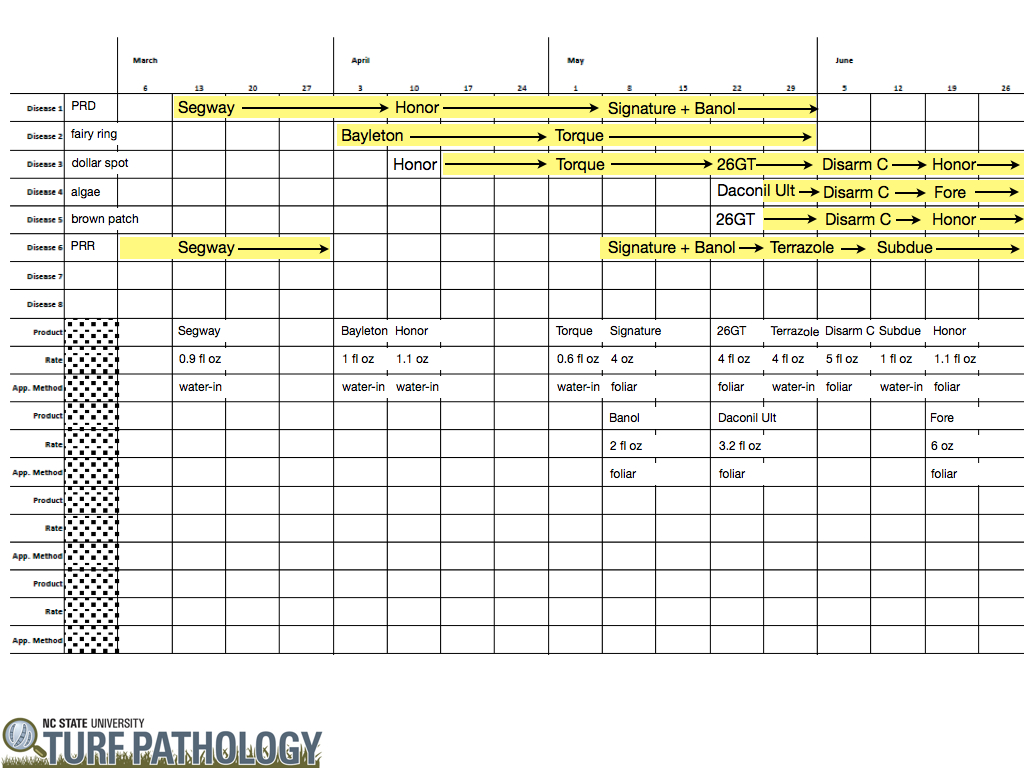
We used an excel spreadsheet to assist with developing the program. The diseases we need to control were listed at the top, with each column across the sheet corresponding to a week during the growing season. Using our knowledge of the weather conditions that trigger each disease and historical weather data from the State Climate Office of North Carolina, we highlighted the weeks that each disease is likely to be active. This gives you a good visual image of what diseases need to be controlled with each fungicide application. We used the Disease Management Utility on Turffiles to select a fungicide or tank-mixture that would control the diseases that are expected to be active during each week. We tried to avoid having to make fungicide applications on back-to-back weeks, but in several cases we needed to do that because application methods (foliar vs. watered-in) were not compatible.

Here's the program we came up with:

March 14:  Segway (0.9 fl oz, watered-in)
April 4:  Bayleton (1 fl oz, watered-in)
April 11:  Honor (1.1 oz, watered-in)
May 2:  Torque (0.6 fl oz, watered-in)
May 9:  Signature + Banol (4 oz + 2 fl oz)
May 23:  26GT + Fore (4 fl oz + 6 oz)
May 30:  Terrazole (4 oz, watered-in)
June 6:  Disarm C (5 fl oz)
June 13:  Subdue Maxx (1 fl oz, watered-in)
June 20:  Honor + Fore (1.1 oz + 6 oz)
July 5:  Signature + Daconil Ultrex (4 oz + 3.2 oz)
July 11:  Segway (0.9 fl oz, watered-in)
July 18:  Disarm C (5 fl oz)
Aug 1:  Stellar + Daconil Ultrex (1.2 fl oz + 3.2 oz)
Aug 15: Spectro + Alude (5.76 oz + 6 fl oz)
Aug 29:  Subdue Maxx + Fore (1 fl oz + 6 oz)
Sept 12:  Reserve (3.2 fl oz)
Sept 26:  26GT + Daconil Ultrex (4 fl oz + 3.2 oz)

If this seems like a lot of applications and an expensive program, you're absolutely right. Several of these applications are specifically to control Pythium root rot, which can develop any time between May and October in North Carolina depending on when the wet weather comes. This is why adjusting your fungicide program based on the current conditions is so important - many of these Pythium applications could be avoided if the weather is dry and unfavorable for Pythium root rot development at that time.

This year we'll be comparing this NC State program to other common fungicide programs, and one that we adjust on the fly based on the current weather conditions, to see which method provides the best disease control and highest turf quality. 

For more information about our Program '11 Project, or to follow along on Facebook or Twitter, please visit our website turfpathology.org.

Friday, April 15, 2011

Program '11: Develop a fungicide program in 4 easy steps

Designing a fungicide program for golf course putting greens is a daunting task, even for the most experienced golf course superintendent. There are many factors to consider, and at times it seems too many products to choose from. However, I think it becomes a lot easier if you break it down into 4 easy steps:
  1. Which diseases do I need to prevent? It should seem obvious that developing a good fungicide program is impossible without first answering this question. You need to know which diseases you're trying to control in order to design a good program! Yet, it is not uncommon for superintendents to skip this step or get it wrong. For example, I see a lot of superintendents throughout NC spraying unnecessarily for take-all patch, which is only a problem at high elevations in the western part of the state. On the other hand, a lot of people with older bentgrass varieties like Pencross, Pennlinks, Dominant, Crenshaw, and L-93 do not treat their greens for anthracnose, which is a common problem on these varieties.
  2. What weather conditions trigger development of these diseases? Now that you've selected the diseases you need to control, it's time to become familiar with the conditions that trigger their development. Each disease develops under a specific set of conditions, whether it be a range in soil temperatures, night temperatures above a certain threshold, or other factors. These conditions, to the best of our knowledge, are explained in detail in our disease profiles. Take the time to become familiar with the diseases you need to control and what conditions favor their development.
  3. When can I expect these diseases to be active in my location? Weather conditions vary widely across a state like North Carolina, so it's not possible for us to develop a blanket recommendation for application timing that everyone can follow. Fortunately, the State Climate Office of North Carolina has 30-year average climate data for a number of weather stations across the state, which are easily accessible on their website. Using this historical weather data, you can pinpoint the approximate date on which diseases will tend to become active. For example, looking at the historical data from Raleigh, night temperatures tend to rise above 50F on May 1. For root diseases, use average daily air temperature to estimate soil temperature. For example, average air temperatures reach 55F on about April 7, so this would be the time to start preventing fairy ring.
  4. Which product or products will control all of the diseases I need to prevent? This is still the hard part, but we've made it a lot easier by answering the first three questions. For every week during the growing season, we know which diseases are expected to be actively developing in the turf. Now all you need to do is work through the season, and for every week make sure that you are protected against those diseases. For this, you need an information source that ranks fungicides based on their effectiveness. The Disease Management Utility on TurfFiles was developed just for this purpose. This online decision aid allows you to select up to 5 diseases and it will return a list of fungicides ranked in order of their average effectiveness against the diseases you selected. Detailed information on each fungicide, including trade names, formulations, application rates, application intervals, and specific application instructions are also available on this system.
If you work your way through these steps, you should come out with a really solid program for your putting greens. Of course, every year is different, and it is important to adjust a program during the season as necessary, again using the conditions that favor your diseases as a guide. Next week, we'll take a look at the fungicide program that we developed using this system, and through this blog we'll keep you up to date on how we change it through the year. Stay tuned in one of the following ways!

Visit our website! turfpathology.org/pages/program11.aspx

Like us on Facebook: facebook.com/turfpathology

Follow us on Twitter: twitter.com/ncturfpathology

RSS Feed for Email or Google Reader: feeds.feedburner.com/turfpathology