Showing posts with label research. Show all posts

Tuesday, January 17, 2012

Status Update: The Show Will Go On

Beginning February 1, I've accepted a new position with Syngenta as a Senior Technical Field Representative for Turf and Landscape. I'll be covering the Southeastern US and will stay in the Raleigh area.

The Turf Pathology Program at NC State has a long, proud history, dating back to the 1970s with Leon Lucas. I wanted to assure everyone that this program will continue to operate as normal (perhaps even better without my interference) during the transition period until the faculty position can be refilled:


I want to sincerely thank everyone in the turfgrass industry for your support since my arrival in 2002. It has been a pleasure to work with all of you, and I am proud to look back on what we've been able to accomplish together. I am looking forward to the new challenges that lie ahead and to maintaining a close relationship with this great industry in my new role with Syngenta.

Thursday, September 1, 2011

Program '11 Update: Stress

A lot has happened since the last update I posted on July 22. We had record attendance of 650 at our NC State Turfgrass Field Day on August 10. Classes are in session, conference season is starting up, and we had an earthquake AND a hurricane in one week. I sincerely hope that everyone who was in the path of Hurricane Irene escaped severe damage.

From mid July to mid August was hot, humid, and stressful for bentgrass putting greens in North Carolina, with 18 days above 95 and 6 days above 100. The low temperature only dipped below 70 degrees once during this time.

We've made several changes to Program '11 in response to the prevailing weather patterns. In response to the severe stress imposed by the weather conditions, we decided to apply Signature + Daconil on August 1 instead of Stellar + Daconil. On August 15, the weather was cooling off and we decided to drop the Alude application and applied Spectro alone.

On August 29, in the wake of Irene, we applied Honor instead of Subdue + Fore. While there was some potential for Pythium root rot development in these wet conditions, we were more concerned about the explosion of dollar spot and brown patch we were observing in untreated areas on the research farm.


All of the programs have continued to provide excellent disease control. No significant amounts of dollar spot, brown patch, anthracnose, or Pythium root rot have been observed in the treated plots. The Bayer Program has continued to express more yellow spot symptoms as I reported in July. This program contains a lot of QoI fungicides, which we've found increase the intensity of yellow spot symptoms.

On July 25, Program 13, NC State Program, BASF Program and Program '11 all exhibited excellent turf quality. Beginning in early to mid July, all programs declined in their turf quality, except for the BASF program which actually continued to slightly improve. Plots treated with the BASF Program has significantly better turf quality than all others on August 16 and 22. The Syngenta Program improved in its turf quality and by August 29 was statistically similar to the BASF Program while all the others were significantly lower.

It is difficult to determine why the BASF Program held up so well during the hot and humid conditions of early July. These plots were treated with a tank-mixture of Segway, Iprodione Pro, and Daconil Ultrex on August 8, which may have helped to control some underlying Pythium root rot or other disease. Perhaps the application of Honor on July 11 helped to precondition the bentgrass for the oncoming stress as BASF promotes.

Friday, July 22, 2011

Program '11 Update: Yellow Spot

As mentioned in a previous post, yellow spot has been particularly bad this year on creeping bentgrass putting greens. We have a lot of it in our Program '11 Trial area so we were able to assess how fungicide programs are influencing the disease.

It is interesting to note that the programs receiving chlorothalonil or mancozeb applications during May and June were relatively clean of yellow spot, especially the SyngentaBASF, and Program '11 treatments. This is consistent with our past observations of effective yellow spot control with chlorothalonil and mancozeb.


For the most part, we stuck to our original plans for Program '11 during July. Most of the changes we make continue to be dictated by dollar spot pressure. We applied Disarm C instead of Honor on June 20 because the Honor was applied earlier on June 6. We also applied Signature + 26GT on July 5 instead of Signature + Daconil Ultrex because dollar spot was continuing to develop and we feared that Daconil alone would not provide sufficient control. Both of these changes may have turned out to be a mistake.

Turf quality dipped to 6 out of 9 in our Program '11 treatment on July 19. Turf in these plots was showing significant signs of stress, thinning, and algae invasion. On the other hand, the NC State Program was among the best treatments in the trial with turf quality of 7 out of 9. The Honor application on June 20 and the Signature + Daconil application on July 5 are most likely responsible for the increased turf quality provided by the NC State Program.

Friday, July 8, 2011

Update on Bacteria in Creeping Bentgrass Greens


In the last month, we've observed significant amounts of bacteria in 32 creeping bentgrass samples submitted to the Turf Diagnostics Lab. We isolated the bacteria in these samples and are identifying them by DNA sequencing and other techniques.

The good news first: the majority of samples contained bacteria that are known to be non-pathogenic to turf. We suspect that these bacterial infections occurred during aerification and topdressings performed after Memorial Day when it was very hot and humid. These non-pathogenic bacteria are not killing the plant directly but may be speeding up the dieback of leaves or tillers that were injured by these stressful practices.

We did isolate the plant pathogenic bacteria Acidovorax from 7 locations, most of which are in the Piedmont of North Carolina. The samples that contain Acidovorax are showing the symptoms of chlorosis, etiolation, and gradual thinning that I wrote about in previous posts. The caveat is that we're not isolating Acidovorax from all of the locations where these symptoms are present. As a result, we cannot be sure that this bacteria is the true cause of the symptoms.

Results from trial on L-93 in Raleigh. Rates are per 1000 sq ft.
We have ongoing trials at 2 locations where Acidovorax is present, and our preliminary data is presented here. First, a word on our rating scale. These ratings are on a 0 to 9 scale, where 0 equals no disease, 1 to 3 represents varying degrees of chlorosis, 4 to 6 represents chlorosis with varying degrees of thinning, and 7 to 9 represent severe thinning of the turf.

Results from trial on G-2 in Charlotte. Rates are per 1000 sq ft.
While we haven't found a silver bullet yet, we have noticed that Signature treatments seem to be helping. In the Raleigh trial, 8 oz of Signature applied 3 times has prevented the turf from thinning, although some chlorosis and etiolation is still evident. In the Charlotte location, plots treated with 8 oz of Signature 3 times have improved slightly, while all other plots have continued to thin.

Before you complain about the price of an 8 oz Signature spray: we don't set the prices, we're just trying to find something that works. We are continuing to evaluate other products and practices that may help to control this problem and will post regular updates on this blog as we learn more.

One important take-home message: just because a diagnostic lab sees bacteria in your bentgrass doesn't mean you have a bacterial disease. Most of the samples we've received have only contained non-pathogenic bacteria. The bacteria has to be isolated and identified in order to determine if it is a plant pathogen.

Friday, June 3, 2011

Type I fairy rings in warm-season grasses

Type I fairy ring symptoms on a bermudagrass fairway
This spring we've seen a tremendous amount of Type I fairy ring on bermudagrass fairways and landscapes established with zoysiagrass and centipedegrass.  Type I fairy ring symptoms are the most severe, causing decline or death of the affected turf. In most cases these symptoms appeared as soon as the turf began to green-up in the spring. The affected turf never greened-up, indicating that it had been killed over the winter.

Note how the symptoms stop near the drainage basin
How and why did this happen? I suspect that these rings began to develop last year during periods of wet weather in the spring. In fact, some people noted that these same areas had green (Type II) fairy ring symptoms last year. All of this fungal growth may have turned the soil hydrophobic, or water-repellent, and caused the turf to be killed by winter desiccation. Or maybe the extra nitrogen released into the soil profile by the fairy ring fungi caused the turf to be more prone to winter injury.

Either way, the important thing now is to take steps to encourage a rapid recovery. Wetting agents or soil surfactants should be used to re-wet the soil in affected areas, and spiking or aerification should be done to break up the mat of dead turf. Avoid application of DNA herbicides, like prodiamine, as these inhibit root growth and will slow recovery. Fungicides probably won't help to speed up the recovery, but they may help to prevent the problem from recurring next year. For a list of fungicides labeled for fairy ring control, please visit the Disease Management Utility on TurfFiles.

For more information on fairy ring, check out our fairy ring disease profile.

Thursday, May 19, 2011

Program '11 Update: Dollar spot and Pythium root rot

We're only two months into our Program '11 Project and are already seeing major differences among the fungicide programs we're evaluating. Here's an update on things:

We've already made a number of changes to the Program '11 treatment because of the continuing cool and wet conditions. Dollar spot pressure has been very high for the last month, and frequent rainfalls have increased the risk for Pythium root rot development. Here are the changes we've made so far:

  1. We were scheduled for a Bayleton application on April 4 for fairy ring prevention, but the soil temperatures were too cool. Instead, we moved-up the application of Honor originally scheduled for April 11 because the weather was very favorable for Pythium root dysfunction and dollar spot.
  2. The Bayleton treatment for fairy ring was applied on April 18 when 5-day average soil temperatures finally reached 55F.
  3. Due to an outbreak of dollar spot in the Program '11 plots, we made an emergency application of Daconil + Torque on April 29. Therefore, we cancelled the application of Torque that was originally scheduled for May 2.
  4. Instead of applying Signature + Banol on May 9, we decided to go with Banol + 26GT on May 12 due to continuing dollar spot pressure and wet conditions favorable for Pythium root rot.

Now to the results:
  • Clemson's Program 13, which hasn't received any fungicide treatments yet, is getting hammered by dollar spot as you would expect
  • The NC State Program has also failed to provide acceptable control of dollar spot. This is probably due to the intense dollar spot pressure this spring combined with the watering-in of most treatments for fairy ring and PRD.
  • The Bayer, Syngenta, BASF, and Program '11 treatments are providing good to excellent dollar spot control.


Turf quality is primarily being affected by dollar spot, so the treatments that are providing good dollar spot control are exhibiting the best turf quality right now. The Bayer and Program '11 treatments have the highest turf quality because they are providing the best dollar spot control. Program 13 and the NC State Program are not providing acceptable turf quality at this point.

For more information about our Program '11 Project, or to follow along on Facebook or Twitter, please visit our website turfpathology.org.

Wednesday, May 4, 2011

Program '11: An example fungicide program

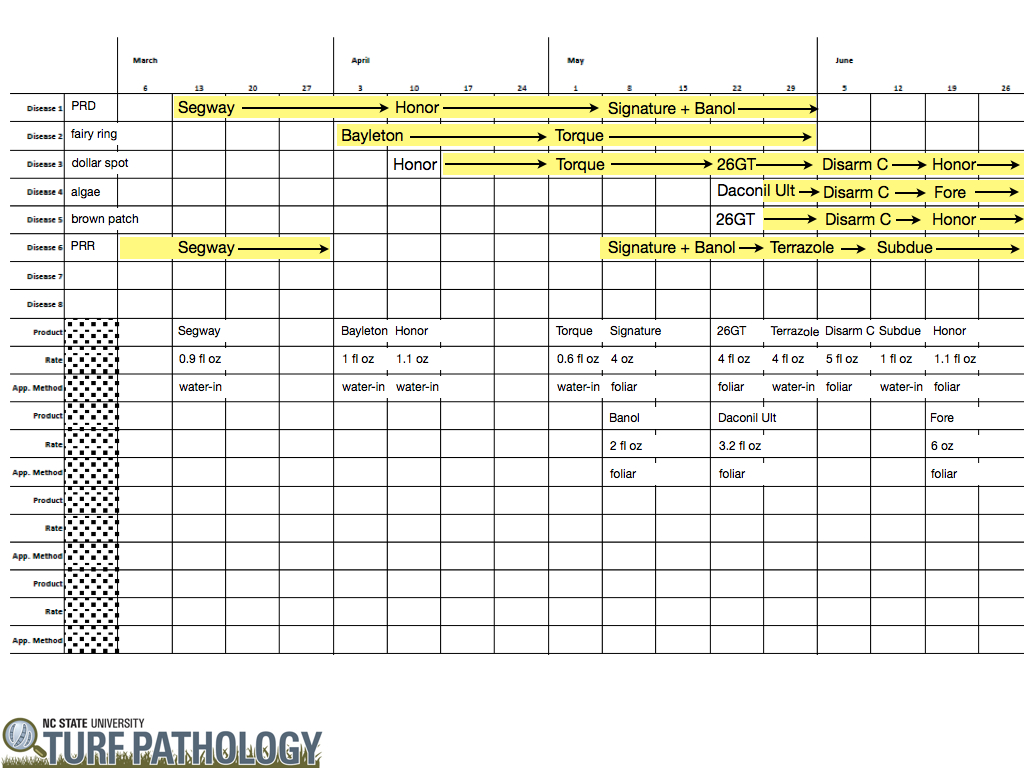
Following the steps I outlined in my last post, we developed a fungicide program for an 'A-1' creeping bentgrass putting green built to USGA specifications in 2005. 

Located on our Lake Wheeler Turf Field Lab, this green has a history of Pythium root dysfunction and fairy ring problems, and we were also hit with Pythium root rot last year during an extended period of wet weather. Dollar spot, brown patch, and algae are also problems on this green as they are on most bentgrass greens.

We used an excel spreadsheet to assist with developing the program. The diseases we need to control were listed at the top, with each column across the sheet corresponding to a week during the growing season. Using our knowledge of the weather conditions that trigger each disease and historical weather data from the State Climate Office of North Carolina, we highlighted the weeks that each disease is likely to be active. This gives you a good visual image of what diseases need to be controlled with each fungicide application. We used the Disease Management Utility on Turffiles to select a fungicide or tank-mixture that would control the diseases that are expected to be active during each week. We tried to avoid having to make fungicide applications on back-to-back weeks, but in several cases we needed to do that because application methods (foliar vs. watered-in) were not compatible.

Here's the program we came up with:

March 14:  Segway (0.9 fl oz, watered-in)
April 4:  Bayleton (1 fl oz, watered-in)
April 11:  Honor (1.1 oz, watered-in)
May 2:  Torque (0.6 fl oz, watered-in)
May 9:  Signature + Banol (4 oz + 2 fl oz)
May 23:  26GT + Fore (4 fl oz + 6 oz)
May 30:  Terrazole (4 oz, watered-in)
June 6:  Disarm C (5 fl oz)
June 13:  Subdue Maxx (1 fl oz, watered-in)
June 20:  Honor + Fore (1.1 oz + 6 oz)
July 5:  Signature + Daconil Ultrex (4 oz + 3.2 oz)
July 11:  Segway (0.9 fl oz, watered-in)
July 18:  Disarm C (5 fl oz)
Aug 1:  Stellar + Daconil Ultrex (1.2 fl oz + 3.2 oz)
Aug 15: Spectro + Alude (5.76 oz + 6 fl oz)
Aug 29:  Subdue Maxx + Fore (1 fl oz + 6 oz)
Sept 12:  Reserve (3.2 fl oz)
Sept 26:  26GT + Daconil Ultrex (4 fl oz + 3.2 oz)

If this seems like a lot of applications and an expensive program, you're absolutely right. Several of these applications are specifically to control Pythium root rot, which can develop any time between May and October in North Carolina depending on when the wet weather comes. This is why adjusting your fungicide program based on the current conditions is so important - many of these Pythium applications could be avoided if the weather is dry and unfavorable for Pythium root rot development at that time.

This year we'll be comparing this NC State program to other common fungicide programs, and one that we adjust on the fly based on the current weather conditions, to see which method provides the best disease control and highest turf quality. 

For more information about our Program '11 Project, or to follow along on Facebook or Twitter, please visit our website turfpathology.org.

Tuesday, March 29, 2011

Program '11: Lessons from 2010

The summer of 2010 was a rough one and an experience that nobody wants to repeat. While new problems like bacterial wilt received a lot of attention in 2010, in reality it was an old problem that caused the majority of damage to creeping bentgrass putting greens in North Carolina: Pythium root rot.


Pythium root rot is brought on by wet soil conditions; temperature doesn't matter. Since there are several Pythium species that can cause root rot, the disease can develop at any time of year as long as the soils are wet. We see Pythium root rot all throughout the year, and even diagnosed a case of it in western North Carolina last week.

Because it needs wet soils, Pythium root rot is most common in poorly drained greens. However, the disease can also occur in newer, well-drained greens if wet weather conditions persist for long enough. That's where spring of 2010 comes into play. Many areas in North Carolina experienced prolonged wet weather conditions during March and/or May, which triggered the development of Pythium root rot.

Our clinic was inundated with cases of Pythium root rot on creeping bentgrass during the first week of June. As soon as the weather turned hot, the plants with weakened, Pythium-infected roots were the first to decline. Most golf courses managed to survive through the initial heat wave in June, but hot and wet weather in July and August finished-off a lot of greens.

The problem is that most fungicide programs for creeping bentgrass greens include no fungicides for Pythium root rot until mid-June. Why wait until June? It's based on the misconception that Pythium diseases only develop during hot weather. We now know with 100% certainty that's not the case.


If you look at average daily rainfall in Raleigh, for example, you'll see that there is no pronounced wet season. Other than drier periods in April and late November, we get about 0.12 to 0.15" of precipitation per day on average from May through November. So when can we expect to see Pythium root rot activity? Any time between May and November, depending on when the rain comes in that particular year.

So what are you supposed to do, spray Pythium fungicides constantly from April through November? You could, but you'd be wasting a lot of money. The key is to adjust your fungicide program as needed during the year based on weather conditions: if it's wet, then treat the greens preventively for Pythium root rot. You simply can't write a Pythium root rot program on the calendar.

To find out more about Program '11, please visit our project website.

Monday, March 21, 2011

Introducing Program '11: The best fungicide program for your putting greens

Developing a fungicide program for putting greens is becoming increasingly complex, thanks mostly to an explosion in the number of products available to turf managers. When I came to NC State in 2002, I think there were about 60 different fungicide products available in the turf market. Now there are at least 120. It's enough to make your head spin.

It's little wonder that many golf course superintendents have gone toward 'canned' fungicide programs developed by university researchers or crop protection companies.

The problem with these programs is that every golf course is different. Just because a program works well on my research green in Raleigh doesn't mean it will work well on your greens. Different environments, microclimates, management practices, cultivars, construction methods, etc. - all of these things influence the potential for diseases to develop.

Furthermore, every year is different. The activity of a given disease can shift by a month or two depending on the weather conditions. Fungicide programs cannot be inked on the calendar and followed like a prescription. They have to be constantly tweaked and adjusted based on the hand that Mother Nature deals you.

So what is Program '11? This is a fungicide program that is specifically tailored for your putting greens, and adjusted for the specific conditions of 2011.

Over the next 6 months on this blog, we'll be chronicling a field experiment where we compare the performance of different fungicide programs, including one dubbed Program '11.  Program '11 was specifically designed for our research green and will be adjusted during the season based on the weather conditions. Along the way, we'll take a more detailed look at how you can develop and implement effective fungicide programs for your putting greens.

You can follow our progress in a number of ways -  choose one or all!

Visit our website! turfpathology.org/pages/program11.aspx

Like us on Facebook: facebook.com/turfpathology

Follow us on Twitter: twitter.com/ncturfpathology

RSS Feed for Email or Google Reader: feeds.feedburner.com/turfpathology

Wednesday, March 9, 2011

Is Emerald a poor curative for dollar spot control?


Over the years, I've heard a number of people say that Emerald is a slow or poor fungicide for curative control of dollar spot. I must confess that I've never understood what everyone is talking about.

Given that boscalid, the active ingredient in Emerald, controls fungi by depleting their energy reserves, it makes sense that it might be a little slow to work on a curative basis. However, in reality, I've always been impressed with it's activity on both a preventive and curative basis.


Let's look at a couple of examples. In this first curative dollar spot control study, we had an average of 40 to 45 dollar spot infection centers in each plot before initiation of treatments. That's not a huge amount of dollar spot on a 20 square foot plot, but certainly enough to warrant a curative fungicide application in a golf course setting.

On July 20, just 5 days after applying the low rate of Emerald, we reduced the number of infection centers down to 2 per plot, whereas the number in untreated plots held constant. So, the low rate of Emerald reduced dollar spot incidence by 95% in 5 days. I'd consider that to be pretty good curative activity! If you're expecting more than this out of a curative application, then you are probably expecting too much.


Looking at some older data, in 2006 we evaluated Emerald, Daconil + Emerald, and Daconil + Banner for curative dollar spot control. In this case, the dollar spot pressure was much more intense, with 150 to 200 dollar spot infection centers per plot before the initiation of treatments. After the first application on 19 Jun, dollar spot incidence declined in all of the treatments at a similar rate and none of the treatments were disease free until three weeks later on 10 Jul. And this is even though dollar spot disease pressure was much lower during late June and early July, as evidenced by the decline in the amount of disease in untreated plots.

Curative control of any disease is more dependent on the level of disease pressure, the amount of turf injury present, and the growth rate of the turf after the application. Which fungicide is applied probably isn't that important in most cases. In order for the disease symptoms to go away, the turf has to grow out of the symptoms and spread into the damaged areas. This, of course, takes time. There aren't any fungicides that will make dollar spot go away over night.

For a lot of reasons, we don't recommend controlling dollar spot on a curative basis. Perhaps the most important reason is that curative applications increase the risk for fungicide resistance to develop. If you find yourself in a situation where you need to make a curative application for dollar spot control, be sure that you are tank-mixing with chlorothalonil to reduce the potential for resistance to develop. This is especially important for products with a high resistance risk like Emerald.

Monday, February 7, 2011

Nitrogen source impacts spring dead spot of bermudagrass

Most turf managers in the southeast and midwest are all too familiar with spring dead spot. However, in light of the results presented below, it is important to realize that the disease is caused by three different species: Ophiosphaerella herpotricha, O. korrae, and O. narmari. The most common species in the southeastern US is O. korrae, whereas O. herpotricha is prevalent in the midwestern US. If you are unsure of which species you have, ask your friendly neighborhood turf pathologist to find out which species is most common in your area.

We initiated this research in 2004 to determine how fertilization programs influence these different spring dead spot species. Each plot was inoculated with O. korrae and O. herpotricha in Fall 2004, fertilization treatments were initiated in May 2006, and were continued through 2007 and 2008.

Some of the main findings of this research are as follows:
  1. Spring dead spot caused by O. herpotricha was suppressed very effectively in all 3 years by fertilization with ammonium sulfate. Sulfur coated urea provided some control in 2008, and calcium nitrate provided moderate suppression in 2009.
  2. Ammonium sulfate had no effect whatsoever on spring dead spot caused by O. korrae. Instead, calcium nitrate provided almost complete control of this species in all 3 years.
  3. Fall applications of potassium, dolomitic lime, gypsum, or elemental sulfur had no effect on either spring dead spot pathogen.


What does this mean? We are unsure at this time if the observed spring dead spot suppression is due to changes in soil pH or other nutritional effects. For example, suppression of O. korrae by caclium nitrate may be due to higher soil pH or increased calcium availability. Regardless, if you have struggled with spring dead spot in the past, take a look at the nitrogen source you've been using and consider a change to either calcium nitrate or ammonium sulfate.

Many turf managers apply potassium in the fall, as this has been thought to help reduce spring dead spot development. During the three years of this study, we saw no benefit from fall applications of potassium or other nutrients. It is important to point out, however, that we applied 2.7 lbs K/1000 sq ft from potassium chloride (0-0-60) during the summer in conjunction with our nitrogen applications. Therefore, as long as adequate amounts of potassium are applied during the season, additional fall applications do not appear to influence spring dead spot development.