Showing posts with label Pythium root dysfunction. Show all posts

Thursday, May 19, 2011

Program '11 Update: Dollar spot and Pythium root rot

We're only two months into our Program '11 Project and are already seeing major differences among the fungicide programs we're evaluating. Here's an update on things:

We've already made a number of changes to the Program '11 treatment because of the continuing cool and wet conditions. Dollar spot pressure has been very high for the last month, and frequent rainfalls have increased the risk for Pythium root rot development. Here are the changes we've made so far:

  1. We were scheduled for a Bayleton application on April 4 for fairy ring prevention, but the soil temperatures were too cool. Instead, we moved-up the application of Honor originally scheduled for April 11 because the weather was very favorable for Pythium root dysfunction and dollar spot.
  2. The Bayleton treatment for fairy ring was applied on April 18 when 5-day average soil temperatures finally reached 55F.
  3. Due to an outbreak of dollar spot in the Program '11 plots, we made an emergency application of Daconil + Torque on April 29. Therefore, we cancelled the application of Torque that was originally scheduled for May 2.
  4. Instead of applying Signature + Banol on May 9, we decided to go with Banol + 26GT on May 12 due to continuing dollar spot pressure and wet conditions favorable for Pythium root rot.

Now to the results:
  • Clemson's Program 13, which hasn't received any fungicide treatments yet, is getting hammered by dollar spot as you would expect
  • The NC State Program has also failed to provide acceptable control of dollar spot. This is probably due to the intense dollar spot pressure this spring combined with the watering-in of most treatments for fairy ring and PRD.
  • The Bayer, Syngenta, BASF, and Program '11 treatments are providing good to excellent dollar spot control.


Turf quality is primarily being affected by dollar spot, so the treatments that are providing good dollar spot control are exhibiting the best turf quality right now. The Bayer and Program '11 treatments have the highest turf quality because they are providing the best dollar spot control. Program 13 and the NC State Program are not providing acceptable turf quality at this point.

For more information about our Program '11 Project, or to follow along on Facebook or Twitter, please visit our website turfpathology.org.

Wednesday, May 4, 2011

Program '11: An example fungicide program

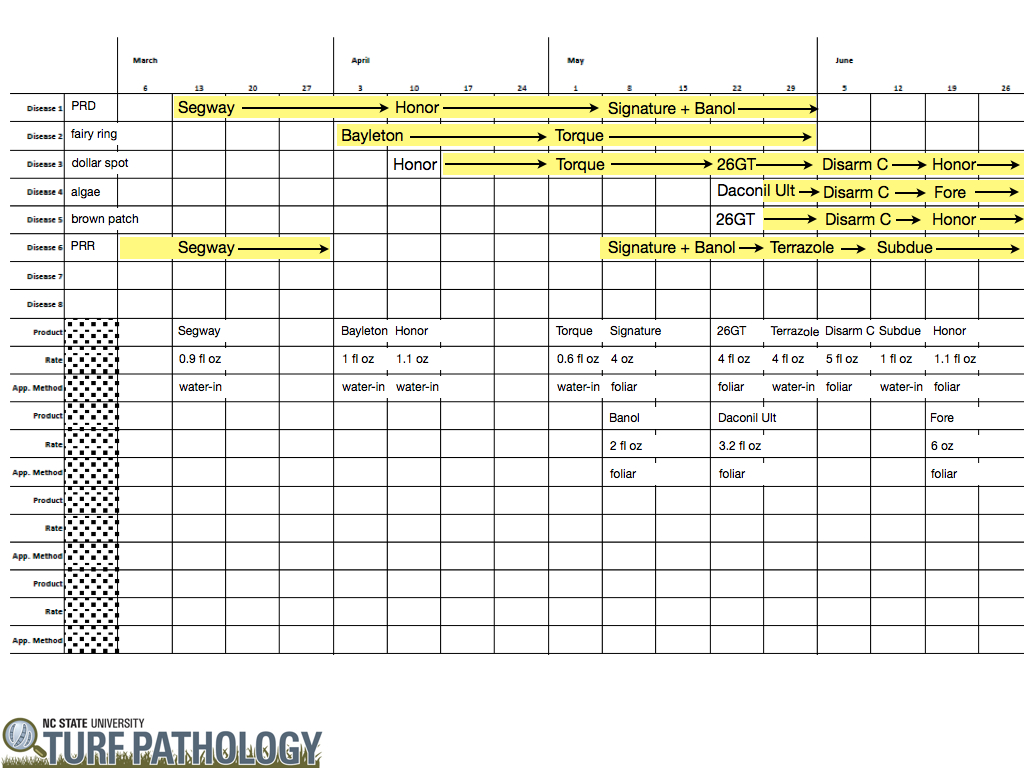
Following the steps I outlined in my last post, we developed a fungicide program for an 'A-1' creeping bentgrass putting green built to USGA specifications in 2005. 

Located on our Lake Wheeler Turf Field Lab, this green has a history of Pythium root dysfunction and fairy ring problems, and we were also hit with Pythium root rot last year during an extended period of wet weather. Dollar spot, brown patch, and algae are also problems on this green as they are on most bentgrass greens.

We used an excel spreadsheet to assist with developing the program. The diseases we need to control were listed at the top, with each column across the sheet corresponding to a week during the growing season. Using our knowledge of the weather conditions that trigger each disease and historical weather data from the State Climate Office of North Carolina, we highlighted the weeks that each disease is likely to be active. This gives you a good visual image of what diseases need to be controlled with each fungicide application. We used the Disease Management Utility on Turffiles to select a fungicide or tank-mixture that would control the diseases that are expected to be active during each week. We tried to avoid having to make fungicide applications on back-to-back weeks, but in several cases we needed to do that because application methods (foliar vs. watered-in) were not compatible.

Here's the program we came up with:

March 14:  Segway (0.9 fl oz, watered-in)
April 4:  Bayleton (1 fl oz, watered-in)
April 11:  Honor (1.1 oz, watered-in)
May 2:  Torque (0.6 fl oz, watered-in)
May 9:  Signature + Banol (4 oz + 2 fl oz)
May 23:  26GT + Fore (4 fl oz + 6 oz)
May 30:  Terrazole (4 oz, watered-in)
June 6:  Disarm C (5 fl oz)
June 13:  Subdue Maxx (1 fl oz, watered-in)
June 20:  Honor + Fore (1.1 oz + 6 oz)
July 5:  Signature + Daconil Ultrex (4 oz + 3.2 oz)
July 11:  Segway (0.9 fl oz, watered-in)
July 18:  Disarm C (5 fl oz)
Aug 1:  Stellar + Daconil Ultrex (1.2 fl oz + 3.2 oz)
Aug 15: Spectro + Alude (5.76 oz + 6 fl oz)
Aug 29:  Subdue Maxx + Fore (1 fl oz + 6 oz)
Sept 12:  Reserve (3.2 fl oz)
Sept 26:  26GT + Daconil Ultrex (4 fl oz + 3.2 oz)

If this seems like a lot of applications and an expensive program, you're absolutely right. Several of these applications are specifically to control Pythium root rot, which can develop any time between May and October in North Carolina depending on when the wet weather comes. This is why adjusting your fungicide program based on the current conditions is so important - many of these Pythium applications could be avoided if the weather is dry and unfavorable for Pythium root rot development at that time.

This year we'll be comparing this NC State program to other common fungicide programs, and one that we adjust on the fly based on the current weather conditions, to see which method provides the best disease control and highest turf quality. 

For more information about our Program '11 Project, or to follow along on Facebook or Twitter, please visit our website turfpathology.org.

Friday, April 15, 2011

Program '11: Develop a fungicide program in 4 easy steps

Designing a fungicide program for golf course putting greens is a daunting task, even for the most experienced golf course superintendent. There are many factors to consider, and at times it seems too many products to choose from. However, I think it becomes a lot easier if you break it down into 4 easy steps:
  1. Which diseases do I need to prevent? It should seem obvious that developing a good fungicide program is impossible without first answering this question. You need to know which diseases you're trying to control in order to design a good program! Yet, it is not uncommon for superintendents to skip this step or get it wrong. For example, I see a lot of superintendents throughout NC spraying unnecessarily for take-all patch, which is only a problem at high elevations in the western part of the state. On the other hand, a lot of people with older bentgrass varieties like Pencross, Pennlinks, Dominant, Crenshaw, and L-93 do not treat their greens for anthracnose, which is a common problem on these varieties.
  2. What weather conditions trigger development of these diseases? Now that you've selected the diseases you need to control, it's time to become familiar with the conditions that trigger their development. Each disease develops under a specific set of conditions, whether it be a range in soil temperatures, night temperatures above a certain threshold, or other factors. These conditions, to the best of our knowledge, are explained in detail in our disease profiles. Take the time to become familiar with the diseases you need to control and what conditions favor their development.
  3. When can I expect these diseases to be active in my location? Weather conditions vary widely across a state like North Carolina, so it's not possible for us to develop a blanket recommendation for application timing that everyone can follow. Fortunately, the State Climate Office of North Carolina has 30-year average climate data for a number of weather stations across the state, which are easily accessible on their website. Using this historical weather data, you can pinpoint the approximate date on which diseases will tend to become active. For example, looking at the historical data from Raleigh, night temperatures tend to rise above 50F on May 1. For root diseases, use average daily air temperature to estimate soil temperature. For example, average air temperatures reach 55F on about April 7, so this would be the time to start preventing fairy ring.
  4. Which product or products will control all of the diseases I need to prevent? This is still the hard part, but we've made it a lot easier by answering the first three questions. For every week during the growing season, we know which diseases are expected to be actively developing in the turf. Now all you need to do is work through the season, and for every week make sure that you are protected against those diseases. For this, you need an information source that ranks fungicides based on their effectiveness. The Disease Management Utility on TurfFiles was developed just for this purpose. This online decision aid allows you to select up to 5 diseases and it will return a list of fungicides ranked in order of their average effectiveness against the diseases you selected. Detailed information on each fungicide, including trade names, formulations, application rates, application intervals, and specific application instructions are also available on this system.
If you work your way through these steps, you should come out with a really solid program for your putting greens. Of course, every year is different, and it is important to adjust a program during the season as necessary, again using the conditions that favor your diseases as a guide. Next week, we'll take a look at the fungicide program that we developed using this system, and through this blog we'll keep you up to date on how we change it through the year. Stay tuned in one of the following ways!

Visit our website! turfpathology.org/pages/program11.aspx

Like us on Facebook: facebook.com/turfpathology

Follow us on Twitter: twitter.com/ncturfpathology

RSS Feed for Email or Google Reader: feeds.feedburner.com/turfpathology

Tuesday, March 29, 2011

Program '11: Lessons from 2010

The summer of 2010 was a rough one and an experience that nobody wants to repeat. While new problems like bacterial wilt received a lot of attention in 2010, in reality it was an old problem that caused the majority of damage to creeping bentgrass putting greens in North Carolina: Pythium root rot.


Pythium root rot is brought on by wet soil conditions; temperature doesn't matter. Since there are several Pythium species that can cause root rot, the disease can develop at any time of year as long as the soils are wet. We see Pythium root rot all throughout the year, and even diagnosed a case of it in western North Carolina last week.

Because it needs wet soils, Pythium root rot is most common in poorly drained greens. However, the disease can also occur in newer, well-drained greens if wet weather conditions persist for long enough. That's where spring of 2010 comes into play. Many areas in North Carolina experienced prolonged wet weather conditions during March and/or May, which triggered the development of Pythium root rot.

Our clinic was inundated with cases of Pythium root rot on creeping bentgrass during the first week of June. As soon as the weather turned hot, the plants with weakened, Pythium-infected roots were the first to decline. Most golf courses managed to survive through the initial heat wave in June, but hot and wet weather in July and August finished-off a lot of greens.

The problem is that most fungicide programs for creeping bentgrass greens include no fungicides for Pythium root rot until mid-June. Why wait until June? It's based on the misconception that Pythium diseases only develop during hot weather. We now know with 100% certainty that's not the case.


If you look at average daily rainfall in Raleigh, for example, you'll see that there is no pronounced wet season. Other than drier periods in April and late November, we get about 0.12 to 0.15" of precipitation per day on average from May through November. So when can we expect to see Pythium root rot activity? Any time between May and November, depending on when the rain comes in that particular year.

So what are you supposed to do, spray Pythium fungicides constantly from April through November? You could, but you'd be wasting a lot of money. The key is to adjust your fungicide program as needed during the year based on weather conditions: if it's wet, then treat the greens preventively for Pythium root rot. You simply can't write a Pythium root rot program on the calendar.

To find out more about Program '11, please visit our project website.

Thursday, March 24, 2011

Pythium Root Dysfunction Alert


Multiple cases of Pythium root dysfunction, caused by Pythium volutum, have been confirmed in our lab from golf courses with creeping bentgrass putting greens throughout the Piedmont and Coastal Plains of North Carolina. The warmer than usual weather conditions have warmed the soil temperatures well into the optimum range for PRD development.

If you've had problems with PRD in the past, then you should have already started your preventative program. Don't worry if you haven't, there's still time to correct this issue before summer arrives. Remember, this is a ROOT DISEASE, therefore you must WATER-IN your fungicide applications to be successful!

For more information about PRD, including specific control recommendations, click here.

Monday, March 14, 2011

Pythium root rot in March?

DSC_1008We diagnosed a case of Pythium root rot on a creeping bentgrass sample that was submitted to the Turf Diagnostics Lab last week. Really? Pythium root rot in March?

Most people don't start to think about Pythium diseases until June or July, but in reality they can occur at almost any time of year. We routinely see symptoms of Pythium root dysfunction as late as October or as early as February.

Pythium root rot can also occur at any time of year. There are many different species of Pythium that can cause root rot, and while most grow at warm or hot temperatures, some others grow at cooler temperatures. The disease is driven by soil moisture: if the soils are wet for extended periods of time, then Pythium root rot can develop. In the case of the sample that was submitted last week, the symptoms appeared after heavy rainfalls over the prior weekend.

I'm not saying that everyone needs to run out and apply a Pythium fungicide. But if you've had issues with Pythium root rot in the past, and you see more wet weather in the forecast, then it might be a good idea.

For more information about Pythium root rot and its management, refer to the disease profile on Turffiles.

Wednesday, February 9, 2011

Watch for winter symptoms of Pythium root dysfunction


Symptoms of Pythium root dysfunction, caused by Pythium volutum, may be expressed this time of year during dry, warm, and/or windy days. This is especially true for newer putting greens or those with low organic matter. Patch type symptoms are typical, however ring type symptoms have been observed.

This pathogen infected your root system last fall and it's those affected plants that will be the first to exhibit symptoms of drought stress. Observing these patches doesn't necessarily mean that the pathogen is currently active, however it does mean that you will have to battle this disease in late spring/early summer if you don't take preventative measures once the daily mean soil temperatures reach 50 degrees Fahrenheit this spring.

For more information about PRD, click here.