Showing posts with label dollar spot. Show all posts

Thursday, May 1, 2014

Return of the Fungi!

Things have been relatively quiet here at the NC State Turf Diagnostics Lab with regards to disease samples, however that has changed in the past couple of weeks now that warm-season turfgrasses are starting to fully wake up from their winter nap. So, without boring you to death with blah blah this and blah blah that ... here's the rundown.

Warm-Season Turf (Bermuda/Zoysia/Centipede)

Many samples have been submitted both digitally and physically to the clinic over the past few weeks that have shown winter damage. The majority of these samples were taken from shady, wet, and/or north facing slopes. These are typical areas we expect to see this type of damage on warm-season turfgrasses. In most cases, it appears that green up has been delayed and no complete turf losses have been reported. The exception to that has been centipedegrass. We have seen some centipede lawns that we can't find any disease, insect, nematode, soil problem, etc. where winter kill is strongly suspected. This is all unfolding as I type this, so we may see cases of other warm season turfs with winter kill as they continue to fully green up across the state. For more information about winter injury in North Carolina, please read Dr. Grady Miller's recent post by clicking here.

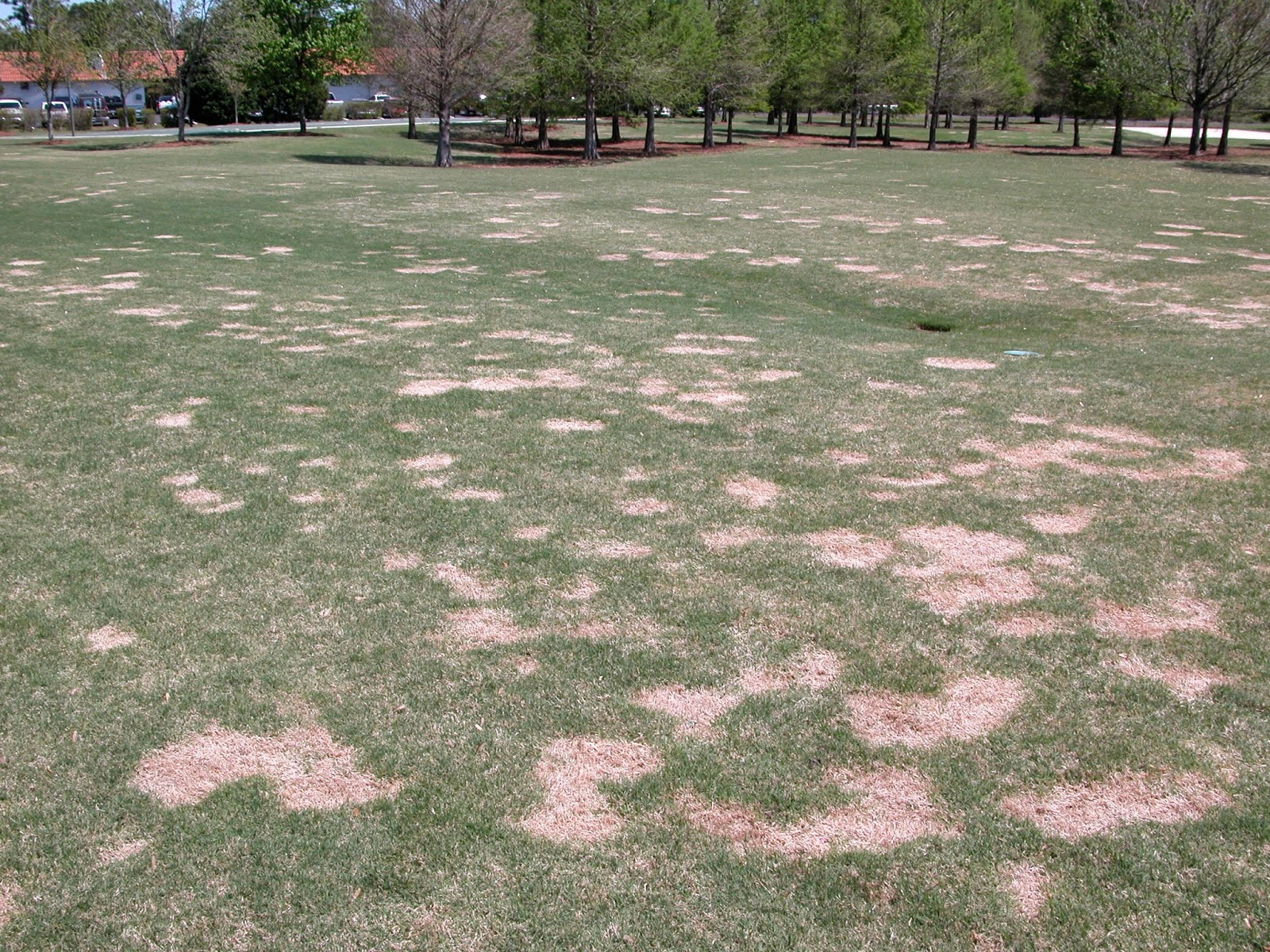
From a disease standpoint, the most common diagnosis in the past week or so has been spring dead spot on bermudagrass. This has been documented on common, hybrid, and ultradwarf types. Given the fact that spring dead spot is highly correlated with cold injury, it is no surprise that there is a lot of spring dead spot damage out there this year in North Carolina. There is nothing you can do from a fungicide standpoint at this time to recover from this disease because the damage was done last fall. For more information about spring dead spot, please click here.

Spring dead spot symptoms on ultradwarf bermudagrass
Spring dead spot symptoms on hybrid bermudagrass
Typical winter kill symptoms on warm season turf


Cool-Season Turf (Bentgrass & Ryegrass)

As expected, we haven't seen many cool-season turf samples in the past few weeks since they are able to withstand the ravages of fungi for the most part in the spring and fall.

One exception has been red leaf spot, caused by the fungus Drechslera erythrospila, on creeping bentgrass putting greens. This is a disease we have observed over the past several years. For the most part, it has been fairly random and isolated, however we are starting to see more and more of this disease for whatever reason. If you think you have red leaf spot, now is the time to treat. None of the samples that have come into the clinic are producing spores yet. This tells us that while the fungus is waking up and starting to infect via mycelium spread, it hasn't reached it's full potential to produce abundant spores. Once spores are produced, the damage will be more widespread and rapid. For more information about red leaf spot, click here.

Red leaf spot symptoms on a creeping bentgrass putting green

Finally, we have observed some dollar spot damage on perennial ryegrass in over seeded situations. Recent weather patterns have been favorable for this fungus to start coming out and eating away at our precious stands of perfect turf, so beware! If you haven't started your preventative dollar spot programs, now's the time ... especially on high value turf like creeping bentgrass. For more information about dollar spot, click here.

Dollar spot symptoms on perennial ryegrass

Thursday, September 1, 2011

Program '11 Update: Stress

A lot has happened since the last update I posted on July 22. We had record attendance of 650 at our NC State Turfgrass Field Day on August 10. Classes are in session, conference season is starting up, and we had an earthquake AND a hurricane in one week. I sincerely hope that everyone who was in the path of Hurricane Irene escaped severe damage.

From mid July to mid August was hot, humid, and stressful for bentgrass putting greens in North Carolina, with 18 days above 95 and 6 days above 100. The low temperature only dipped below 70 degrees once during this time.

We've made several changes to Program '11 in response to the prevailing weather patterns. In response to the severe stress imposed by the weather conditions, we decided to apply Signature + Daconil on August 1 instead of Stellar + Daconil. On August 15, the weather was cooling off and we decided to drop the Alude application and applied Spectro alone.

On August 29, in the wake of Irene, we applied Honor instead of Subdue + Fore. While there was some potential for Pythium root rot development in these wet conditions, we were more concerned about the explosion of dollar spot and brown patch we were observing in untreated areas on the research farm.


All of the programs have continued to provide excellent disease control. No significant amounts of dollar spot, brown patch, anthracnose, or Pythium root rot have been observed in the treated plots. The Bayer Program has continued to express more yellow spot symptoms as I reported in July. This program contains a lot of QoI fungicides, which we've found increase the intensity of yellow spot symptoms.

On July 25, Program 13, NC State Program, BASF Program and Program '11 all exhibited excellent turf quality. Beginning in early to mid July, all programs declined in their turf quality, except for the BASF program which actually continued to slightly improve. Plots treated with the BASF Program has significantly better turf quality than all others on August 16 and 22. The Syngenta Program improved in its turf quality and by August 29 was statistically similar to the BASF Program while all the others were significantly lower.

It is difficult to determine why the BASF Program held up so well during the hot and humid conditions of early July. These plots were treated with a tank-mixture of Segway, Iprodione Pro, and Daconil Ultrex on August 8, which may have helped to control some underlying Pythium root rot or other disease. Perhaps the application of Honor on July 11 helped to precondition the bentgrass for the oncoming stress as BASF promotes.

Friday, June 3, 2011

Program '11 Update: More Dollar Spot and Brown Patch

Dollar spot pressure has continued to be very high, and brown patch exploded over the last week as well. For our Program '11 treatment, we proceeded as planned on May 23 with an application of 26GT (4 fl oz) + Fore (6 oz). We also made the scheduled application of Terrazole (4 oz, watered-in) to clean up any Pythium root rot activity that may have been triggered by recent wet weather.

The changes that we made to Program '11 have done a good job of getting the dollar spot under control. In fact, Program '11 is the only treatment that is clean of dollar spot this week. All of the other programs contain noticeable amounts of the disease.

All of the programs are providing excellent brown patch control.

Turf quality is still mostly being impacted by dollar spot. Only Program '11 and the Bayer Program are providing acceptable (>5) turf quality, with Program '11 providing significantly greater quality than all other treatments.

For more information about our Program '11 Project, or to follow along on Facebook or Twitter, please visit our website turfpathology.org.

Thursday, May 19, 2011

Program '11 Update: Dollar spot and Pythium root rot

We're only two months into our Program '11 Project and are already seeing major differences among the fungicide programs we're evaluating. Here's an update on things:

We've already made a number of changes to the Program '11 treatment because of the continuing cool and wet conditions. Dollar spot pressure has been very high for the last month, and frequent rainfalls have increased the risk for Pythium root rot development. Here are the changes we've made so far:

  1. We were scheduled for a Bayleton application on April 4 for fairy ring prevention, but the soil temperatures were too cool. Instead, we moved-up the application of Honor originally scheduled for April 11 because the weather was very favorable for Pythium root dysfunction and dollar spot.
  2. The Bayleton treatment for fairy ring was applied on April 18 when 5-day average soil temperatures finally reached 55F.
  3. Due to an outbreak of dollar spot in the Program '11 plots, we made an emergency application of Daconil + Torque on April 29. Therefore, we cancelled the application of Torque that was originally scheduled for May 2.
  4. Instead of applying Signature + Banol on May 9, we decided to go with Banol + 26GT on May 12 due to continuing dollar spot pressure and wet conditions favorable for Pythium root rot.

Now to the results:
  • Clemson's Program 13, which hasn't received any fungicide treatments yet, is getting hammered by dollar spot as you would expect
  • The NC State Program has also failed to provide acceptable control of dollar spot. This is probably due to the intense dollar spot pressure this spring combined with the watering-in of most treatments for fairy ring and PRD.
  • The Bayer, Syngenta, BASF, and Program '11 treatments are providing good to excellent dollar spot control.


Turf quality is primarily being affected by dollar spot, so the treatments that are providing good dollar spot control are exhibiting the best turf quality right now. The Bayer and Program '11 treatments have the highest turf quality because they are providing the best dollar spot control. Program 13 and the NC State Program are not providing acceptable turf quality at this point.

For more information about our Program '11 Project, or to follow along on Facebook or Twitter, please visit our website turfpathology.org.

Wednesday, May 11, 2011

Program '11 Project: Here are the programs


As part of the Program '11 Project, we will be evaluating several popular fungicide programs for creeping bentgrass greens, and comparing them to a program that we developed for our specific location (NC State Program) and another program that is modified based on this year's weather conditions (Program '11).

You can find all of the details of each program by following the links below:


We'll be providing regular updates during the season on the performance of these programs and how we've adjusted Program '11 based on this year's weather conditions.

For more information about our Program '11 Project, or to follow along on Facebook or Twitter, please visit our website turfpathology.org.

Wednesday, May 4, 2011

Program '11: An example fungicide program

Following the steps I outlined in my last post, we developed a fungicide program for an 'A-1' creeping bentgrass putting green built to USGA specifications in 2005. 

Located on our Lake Wheeler Turf Field Lab, this green has a history of Pythium root dysfunction and fairy ring problems, and we were also hit with Pythium root rot last year during an extended period of wet weather. Dollar spot, brown patch, and algae are also problems on this green as they are on most bentgrass greens.

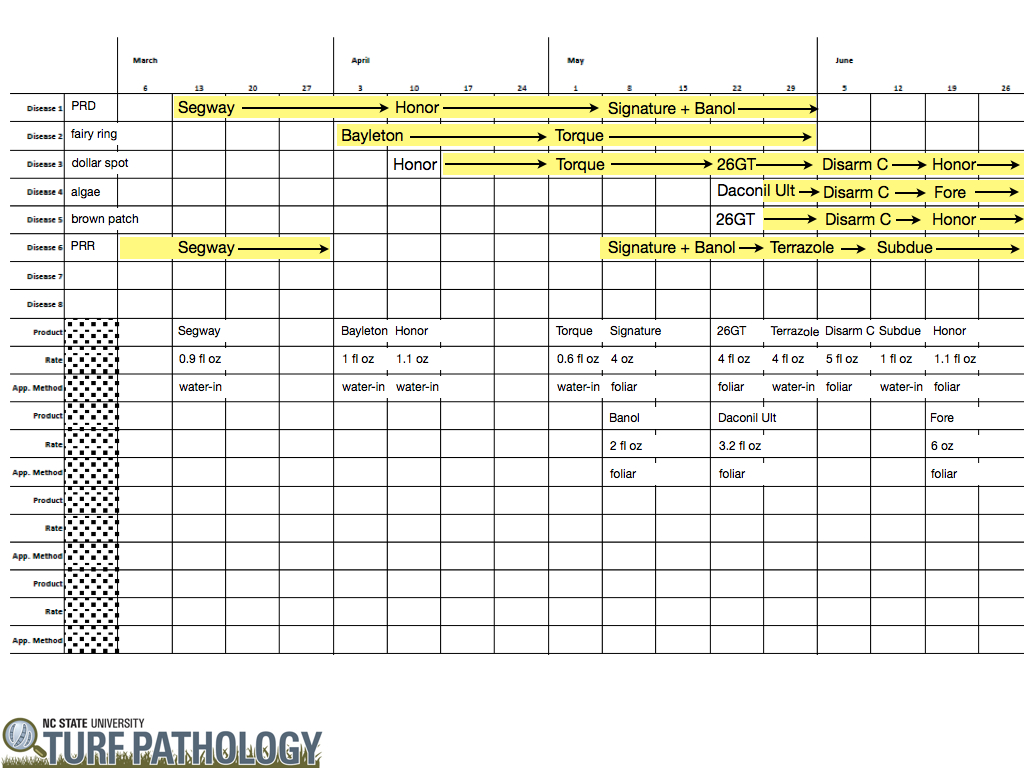
We used an excel spreadsheet to assist with developing the program. The diseases we need to control were listed at the top, with each column across the sheet corresponding to a week during the growing season. Using our knowledge of the weather conditions that trigger each disease and historical weather data from the State Climate Office of North Carolina, we highlighted the weeks that each disease is likely to be active. This gives you a good visual image of what diseases need to be controlled with each fungicide application. We used the Disease Management Utility on Turffiles to select a fungicide or tank-mixture that would control the diseases that are expected to be active during each week. We tried to avoid having to make fungicide applications on back-to-back weeks, but in several cases we needed to do that because application methods (foliar vs. watered-in) were not compatible.

Here's the program we came up with:

March 14:  Segway (0.9 fl oz, watered-in)
April 4:  Bayleton (1 fl oz, watered-in)
April 11:  Honor (1.1 oz, watered-in)
May 2:  Torque (0.6 fl oz, watered-in)
May 9:  Signature + Banol (4 oz + 2 fl oz)
May 23:  26GT + Fore (4 fl oz + 6 oz)
May 30:  Terrazole (4 oz, watered-in)
June 6:  Disarm C (5 fl oz)
June 13:  Subdue Maxx (1 fl oz, watered-in)
June 20:  Honor + Fore (1.1 oz + 6 oz)
July 5:  Signature + Daconil Ultrex (4 oz + 3.2 oz)
July 11:  Segway (0.9 fl oz, watered-in)
July 18:  Disarm C (5 fl oz)
Aug 1:  Stellar + Daconil Ultrex (1.2 fl oz + 3.2 oz)
Aug 15: Spectro + Alude (5.76 oz + 6 fl oz)
Aug 29:  Subdue Maxx + Fore (1 fl oz + 6 oz)
Sept 12:  Reserve (3.2 fl oz)
Sept 26:  26GT + Daconil Ultrex (4 fl oz + 3.2 oz)

If this seems like a lot of applications and an expensive program, you're absolutely right. Several of these applications are specifically to control Pythium root rot, which can develop any time between May and October in North Carolina depending on when the wet weather comes. This is why adjusting your fungicide program based on the current conditions is so important - many of these Pythium applications could be avoided if the weather is dry and unfavorable for Pythium root rot development at that time.

This year we'll be comparing this NC State program to other common fungicide programs, and one that we adjust on the fly based on the current weather conditions, to see which method provides the best disease control and highest turf quality. 

For more information about our Program '11 Project, or to follow along on Facebook or Twitter, please visit our website turfpathology.org.

Friday, April 15, 2011

Program '11: Develop a fungicide program in 4 easy steps

Designing a fungicide program for golf course putting greens is a daunting task, even for the most experienced golf course superintendent. There are many factors to consider, and at times it seems too many products to choose from. However, I think it becomes a lot easier if you break it down into 4 easy steps:
  1. Which diseases do I need to prevent? It should seem obvious that developing a good fungicide program is impossible without first answering this question. You need to know which diseases you're trying to control in order to design a good program! Yet, it is not uncommon for superintendents to skip this step or get it wrong. For example, I see a lot of superintendents throughout NC spraying unnecessarily for take-all patch, which is only a problem at high elevations in the western part of the state. On the other hand, a lot of people with older bentgrass varieties like Pencross, Pennlinks, Dominant, Crenshaw, and L-93 do not treat their greens for anthracnose, which is a common problem on these varieties.
  2. What weather conditions trigger development of these diseases? Now that you've selected the diseases you need to control, it's time to become familiar with the conditions that trigger their development. Each disease develops under a specific set of conditions, whether it be a range in soil temperatures, night temperatures above a certain threshold, or other factors. These conditions, to the best of our knowledge, are explained in detail in our disease profiles. Take the time to become familiar with the diseases you need to control and what conditions favor their development.
  3. When can I expect these diseases to be active in my location? Weather conditions vary widely across a state like North Carolina, so it's not possible for us to develop a blanket recommendation for application timing that everyone can follow. Fortunately, the State Climate Office of North Carolina has 30-year average climate data for a number of weather stations across the state, which are easily accessible on their website. Using this historical weather data, you can pinpoint the approximate date on which diseases will tend to become active. For example, looking at the historical data from Raleigh, night temperatures tend to rise above 50F on May 1. For root diseases, use average daily air temperature to estimate soil temperature. For example, average air temperatures reach 55F on about April 7, so this would be the time to start preventing fairy ring.
  4. Which product or products will control all of the diseases I need to prevent? This is still the hard part, but we've made it a lot easier by answering the first three questions. For every week during the growing season, we know which diseases are expected to be actively developing in the turf. Now all you need to do is work through the season, and for every week make sure that you are protected against those diseases. For this, you need an information source that ranks fungicides based on their effectiveness. The Disease Management Utility on TurfFiles was developed just for this purpose. This online decision aid allows you to select up to 5 diseases and it will return a list of fungicides ranked in order of their average effectiveness against the diseases you selected. Detailed information on each fungicide, including trade names, formulations, application rates, application intervals, and specific application instructions are also available on this system.
If you work your way through these steps, you should come out with a really solid program for your putting greens. Of course, every year is different, and it is important to adjust a program during the season as necessary, again using the conditions that favor your diseases as a guide. Next week, we'll take a look at the fungicide program that we developed using this system, and through this blog we'll keep you up to date on how we change it through the year. Stay tuned in one of the following ways!

Visit our website! turfpathology.org/pages/program11.aspx

Like us on Facebook: facebook.com/turfpathology

Follow us on Twitter: twitter.com/ncturfpathology

RSS Feed for Email or Google Reader: feeds.feedburner.com/turfpathology

Friday, March 18, 2011

Hit two birds with one stone using the DMIs

Although it's not yet officially spring, temperatures across North Carolina are becoming conducive to two common spring diseases: dollar spot and fairy ring. Now's the best time to initiate preventive fungicide programs for these diseases.

The dollar spot pathogen becomes active when low temperatures are consistently above 50ºF, especially when combined with heavy dew formation during the night. Looking at the forecast for the next week, low temperatures will remain in the low- to mid-50s for about another week in Wilmington, Raleigh, Greensboro, and Charlotte.

For greens established with creeping bentgrass, we recommend initiating preventive fungicide treatments for fairy ring when 5-day average soil temperature reaches 55ºF. Most of North Carolina will be hitting that mark over the next week as well.


Our recent research shows that the DMI fungicides, like Bayleton, Torque, Tourney, and Triton, are very effective for fairy ring prevention. These treatments, even though they are watered into the soil, will also provide excellent dollar spot control because the DMIs are translocated upward in the plant. So, in the current environment where everyone is looking to save money, the DMIs are an excellent way to control both dollar spot and fairy ring with one application!

For more information, please visit our disease profiles on dollar spot and fairy ring, or the Disease Management Utility for assistance in selecting a fungicide and application rate.

Wednesday, March 9, 2011

Is Emerald a poor curative for dollar spot control?


Over the years, I've heard a number of people say that Emerald is a slow or poor fungicide for curative control of dollar spot. I must confess that I've never understood what everyone is talking about.

Given that boscalid, the active ingredient in Emerald, controls fungi by depleting their energy reserves, it makes sense that it might be a little slow to work on a curative basis. However, in reality, I've always been impressed with it's activity on both a preventive and curative basis.


Let's look at a couple of examples. In this first curative dollar spot control study, we had an average of 40 to 45 dollar spot infection centers in each plot before initiation of treatments. That's not a huge amount of dollar spot on a 20 square foot plot, but certainly enough to warrant a curative fungicide application in a golf course setting.

On July 20, just 5 days after applying the low rate of Emerald, we reduced the number of infection centers down to 2 per plot, whereas the number in untreated plots held constant. So, the low rate of Emerald reduced dollar spot incidence by 95% in 5 days. I'd consider that to be pretty good curative activity! If you're expecting more than this out of a curative application, then you are probably expecting too much.


Looking at some older data, in 2006 we evaluated Emerald, Daconil + Emerald, and Daconil + Banner for curative dollar spot control. In this case, the dollar spot pressure was much more intense, with 150 to 200 dollar spot infection centers per plot before the initiation of treatments. After the first application on 19 Jun, dollar spot incidence declined in all of the treatments at a similar rate and none of the treatments were disease free until three weeks later on 10 Jul. And this is even though dollar spot disease pressure was much lower during late June and early July, as evidenced by the decline in the amount of disease in untreated plots.

Curative control of any disease is more dependent on the level of disease pressure, the amount of turf injury present, and the growth rate of the turf after the application. Which fungicide is applied probably isn't that important in most cases. In order for the disease symptoms to go away, the turf has to grow out of the symptoms and spread into the damaged areas. This, of course, takes time. There aren't any fungicides that will make dollar spot go away over night.

For a lot of reasons, we don't recommend controlling dollar spot on a curative basis. Perhaps the most important reason is that curative applications increase the risk for fungicide resistance to develop. If you find yourself in a situation where you need to make a curative application for dollar spot control, be sure that you are tank-mixing with chlorothalonil to reduce the potential for resistance to develop. This is especially important for products with a high resistance risk like Emerald.