Showing posts with label spring dead spot. Show all posts

Thursday, May 1, 2014

Return of the Fungi!

Things have been relatively quiet here at the NC State Turf Diagnostics Lab with regards to disease samples, however that has changed in the past couple of weeks now that warm-season turfgrasses are starting to fully wake up from their winter nap. So, without boring you to death with blah blah this and blah blah that ... here's the rundown.

Warm-Season Turf (Bermuda/Zoysia/Centipede)

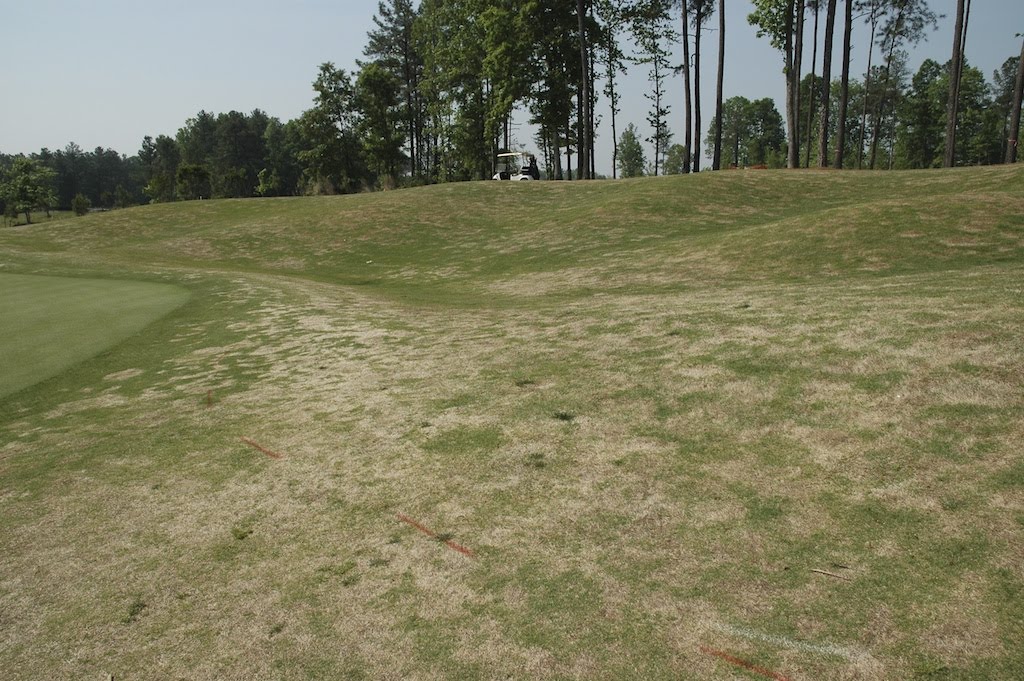
Many samples have been submitted both digitally and physically to the clinic over the past few weeks that have shown winter damage. The majority of these samples were taken from shady, wet, and/or north facing slopes. These are typical areas we expect to see this type of damage on warm-season turfgrasses. In most cases, it appears that green up has been delayed and no complete turf losses have been reported. The exception to that has been centipedegrass. We have seen some centipede lawns that we can't find any disease, insect, nematode, soil problem, etc. where winter kill is strongly suspected. This is all unfolding as I type this, so we may see cases of other warm season turfs with winter kill as they continue to fully green up across the state. For more information about winter injury in North Carolina, please read Dr. Grady Miller's recent post by clicking here.

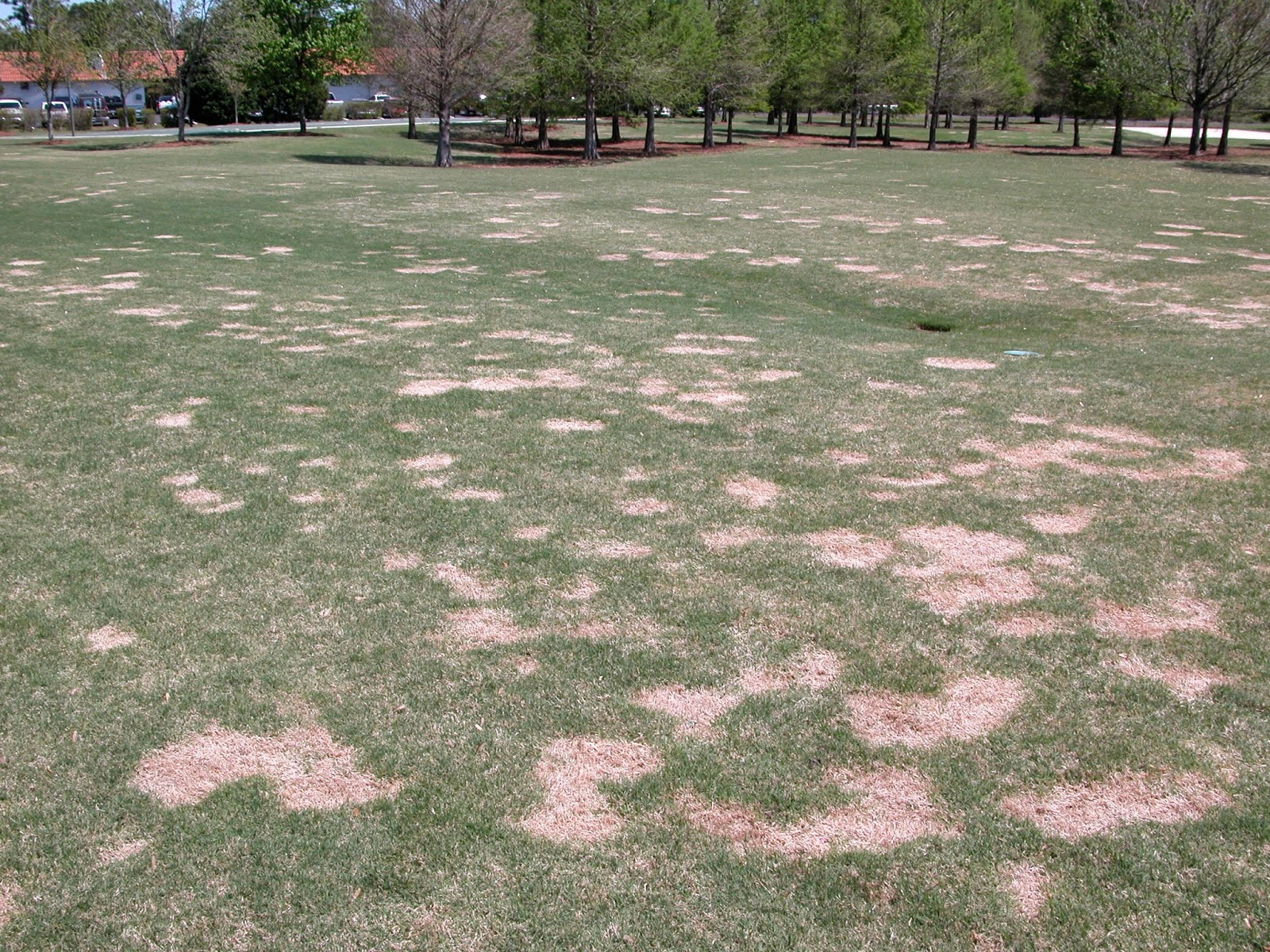
From a disease standpoint, the most common diagnosis in the past week or so has been spring dead spot on bermudagrass. This has been documented on common, hybrid, and ultradwarf types. Given the fact that spring dead spot is highly correlated with cold injury, it is no surprise that there is a lot of spring dead spot damage out there this year in North Carolina. There is nothing you can do from a fungicide standpoint at this time to recover from this disease because the damage was done last fall. For more information about spring dead spot, please click here.

Spring dead spot symptoms on ultradwarf bermudagrass
Spring dead spot symptoms on hybrid bermudagrass
Typical winter kill symptoms on warm season turf


Cool-Season Turf (Bentgrass & Ryegrass)

As expected, we haven't seen many cool-season turf samples in the past few weeks since they are able to withstand the ravages of fungi for the most part in the spring and fall.

One exception has been red leaf spot, caused by the fungus Drechslera erythrospila, on creeping bentgrass putting greens. This is a disease we have observed over the past several years. For the most part, it has been fairly random and isolated, however we are starting to see more and more of this disease for whatever reason. If you think you have red leaf spot, now is the time to treat. None of the samples that have come into the clinic are producing spores yet. This tells us that while the fungus is waking up and starting to infect via mycelium spread, it hasn't reached it's full potential to produce abundant spores. Once spores are produced, the damage will be more widespread and rapid. For more information about red leaf spot, click here.

Red leaf spot symptoms on a creeping bentgrass putting green

Finally, we have observed some dollar spot damage on perennial ryegrass in over seeded situations. Recent weather patterns have been favorable for this fungus to start coming out and eating away at our precious stands of perfect turf, so beware! If you haven't started your preventative dollar spot programs, now's the time ... especially on high value turf like creeping bentgrass. For more information about dollar spot, click here.

Dollar spot symptoms on perennial ryegrass

Wednesday, October 2, 2013

What's Happening Now?


RECENT CREEPING BENTGRASS PROBLEMS

Over the past several weeks, we have received many creeping bentgrass putting green samples.  In every case, samples were submitted to check for a disease and in EACH case absolutely no pathogen activity was discovered.  Therefore, our diagnosis was "a disease was not responsible for the damage".  The common thread has been the combination of core aerification and topdressing with the unusually arid weather for this time of year. When the putting surfaces are opened up after aerification, they are more susceptible to drought stress, especially if the humidity is very low. This effect is exacerbated in areas that are already stressed such as clean up laps, heavy on/off traffic spots, etc.

This is a fine example of why receiving a diagnosis of "no disease" is just as important as receiving a diagnosis of an actual disease. Because symptoms developed during excellent growing conditions for creeping bentgrass, a safe assumption is a disease is responsible for the damage.  Yet, in this case an accurate diagnosis can save time and money by preventing unwarranted fungicide applications.  If you don't agree, feel free to make a fungicide application for drought stress and see what happens.

Typical Stress Symptoms Observed with Recent Samples


TREAT FOR LARGE PATCH NOW!

With soil temperatures starting to approach 70°F across portions of NC, now is the time to treat for large patch.

Average Daily Soil Temperatures as of 10/01/13 via NC State Climate Office

Large patch, which is caused by the fungus Rhizoctonia solani, is a common disease of centipedegrass, St. Augustinegrass, zoysiagrass, and bermudagrass grown for lawns, landscapes, golf turf, and athletic fields. Centipedegrass and St. Augustinegrass are particularly susceptible to severe damage from this disease.

Symptoms of large patch appear in roughly circular patches from 2 feet up to 10 feet or more in diameter. The affected turf will initially be orange, yellow, or reddish-brown in color but will then turn tan and collapse to the ground. The disease can spread rapidly to encompass large areas of turf, and distinct circular patches may not be obvious in these cases.

Fungicides are available for large patch control, but they must be applied preventatively for best results. The first application should be made in the late summer or early fall when average daily soil temperatures are 70°F or below.

One fungicide application will control minor cases of large patch, but two to three applications on a 4 to 6 week interval may be needed to control severe cases. Fungicides are not very effective once the symptoms of large patch appear. Curative applications will help to reduce further spread of the disease, but the affected turf will be very slow to recover.

For more information about Large Patch, including images and specific control recommendations, click here.


TREAT FOR SPRING DEAD SPOT NOW

So, your first question may be "Why on Earth are you telling me to apply fungicides for a spring disease in the fall and for something that will not show up for another 6-7 months?!"  The answer is simple.  The causal fungus, Ophiosphaerella spp., is active RIGHT NOW and you can bet it's infecting your bermuda and zoysia grass plants as I type this blog.  We know through years of research that fungicides are most effective when the soil temperatures are between  60 - 80°F in the fall of the year.

Choosing the right fungicide and applying at the right time will not result in acceptable levels of control if you do not apply them correctly.  Spring dead spot infects below ground plant parts.  With that being said, you must either water-in your fungicide applications IMMEDIATELY  with 1/4" of irrigation or apply with a carrier volume of 5 gal/water/1,000 sq. ft.  You need to be running your irrigation the moment the applicator is out of the way.  Do not wait until the following evening or night with your routine irrigation schedule or else you may be severely disappointed come next spring when these grasses green back up.

Just recently we have made some fantastic discoveries with fertilizers in regards to controlling this disease without having to use fungicides at all!  To learn more about this, please click here.

To learn much more about spring dead spot, including control recommendations, please click here.


Monday, September 17, 2012

Treat for Spring Dead Spot Now!


So, your first question may be "Why on Earth are you telling me to apply fungicides for a spring disease in the fall and for something that will not show up for another 6-7 months?!"  The answer is simple.  The causal fungus, Ophiosphaerella spp., is active RIGHT NOW and you can bet it's infecting your bermuda and zoysia grass plants as I type this blog.  We know through years of research that fungicides are most effective when the soil temperatures are between  60 - 80°F in the fall of the year.

Average Daily Soil Temperatures on 9/15/12 via NC State Climate Office

As you can see by the map above, the time is right for preventative applications. However, choosing the right fungicide and applying at the right time will not result in acceptable levels of control if you do not apply them correctly.  Spring dead spot infects below ground plant parts.  With that being said, you must either water-in your fungicide applications IMMEDIATELY  with 1/4" of irrigation or apply with a carrier volume of 5 gal/water/1,000 sq. ft.  You need to be running your irrigation the moment the applicator is out of the way.  Do not wait until the following evening or night with your routine irrigation schedule or else you may be severely disappointed come next spring when these grasses green back up.

Just recently we have made some fantastic discoveries with fertilizers in regards to controlling this disease without having to use fungicides at all!  To learn more about this, please click here.

Also, if you haven't heard, Rubigan will be coming off the market in December of 2012.  Rubigan is one of the better fungicides available for spring dead spot control.  To learn more about this, click here.

To learn much more about spring dead spot, including control recommendations and images, please click here.

Friday, September 23, 2011

It's Officially Fall! Treat Now for Spring Dead Spot!

So, your first question may be "Why on Earth are you telling me to apply fungicides for a spring disease in the fall and for something that will not show up for another 6-7 months?!"  The answer is simple.  The causal fungus, Ophiosphaerella spp., is active RIGHT NOW and you can bet it's infecting your bermuda and zoysia grass plants as I type this blog.  We know through years of research that fungicides are most effective when the soil temperatures are between  60 - 80°F in the fall of the year.


Average Daily Soil Temperature on 9/22/2011 via NC State Climate Office


As you can see by the map above, the time is right for preventative applications. However, choosing the right fungicide and applying at the right time will not result in acceptable levels of control if you do not apply them correctly.  Spring dead spot infects below ground plant parts.  With that being said, you must either water-in your fungicide applications IMMEDIATELY  with 1/4" of irrigation or apply with a carrier volume of 5 gal/water/1,000 sq. ft.  You need to be running your irrigation the moment the applicator is out of the way.  Do not wait until the following evening or night with your routine irrigation schedule or else you may be severely disappointed come next spring when these grasses green back up.

Just recently we have made some fantastic discoveries with fertilizers in regards to controlling this disease without having to use fungicides at all!  To learn more about this, please click here.

Also, if you haven't heard, Rubigan will be coming off the market in December of 2012.  Rubigan is one of the better fungicides available for spring dead spot control.  To learn more about this, click here.

To learn much more about spring dead spot, including control recommendations and images, please click here.


Thursday, September 15, 2011

Getting ready for life without Rubigan

Is this what life will look like without Rubigan?
A lot of people have heard about Rubigan going off the market in December 2012. If you have questions or concerns, please check out yesterday's post on turfdiseases.org entitled "What will we do when Rubigan is Rubi-gone?".

We are planning a lot more spring dead spot research this fall in response to this issue, so we'll probably be in touch with some of you about the possibility of doing research at your facilities.

Tuesday, April 19, 2011

Speeding the recovery from spring dead spot


From what I've seen and heard, spring dead spot is particularly severe this year, which isn't a surprise given the cold winter with alternating wet and dry periods. These types of conditions are ideal for spring dead spot.

Unfortunately, there is nothing you can do in the spring to control spring dead spot. The pathogen does its damage in the fall and early winter, which causes the turf to be more susceptible to freezing injury. Even though you see the symptoms now, the disease isn't actively developing at this time.

The best you can do is to take steps to speed the bermudagrass recovery from the spring dead spot symptoms. Recovery from spring dead spot occurs primarily through the spread of stolons into the patch from the outside. There are several ways this can be accelerated:

1. Avoid use of DNA herbicides, like prodiamine, for pre-emergence control of crabgrass and other annual grasses. These herbicides inhibit turf root growth and will prevent the bermudagrass stolons from rooting as they spread into the patch from the outside. Oxadiazon is recommended instead because it does not inhibit root growth.

2. Break up the layer of dead turf in the spring dead spot patches through spiking or hollow-tine aerification. Roots emerging from the bermudagrass stolons cannot penetrate through this layer of dead turf to reach the soil below. Just like a grow-in situation, you need to establish good stolon-soil contact.

3. Apply fertilizer and irrigation in light and frequent doses, again mimicking a grow-in situation, to encourage growth of the poorly-rooted stolons. Note that the total amount of fertilization should not be increased, as any excess residual nitrogen remaining in the fall could exacerbate the disease.

For more information about spring dead spot, please see our spring dead spot disease profile.

Tuesday, March 8, 2011

How's the spring dead spot?


This is probably the most common question I get this time of year as everyone anxiously waits to see how much disease there will be this year or if their preventive fungicide applications worked. Based on our winter weather conditions, with cold temperatures combined with periods of wet and dry weather, I expect the disease to be pretty severe this year and early reports seem to indicate that it's going to be a bad year. We've even had a report of a severe outbreak of the disease on zoysiagrass fairways.

Unfortunately, my travel is limited this time of year due to classes and conferences, so let me ask you: How's the spring dead spot out there? Any particular successes or failures with fungicides? Please post a comment to let us know what you're seeing!

Monday, February 7, 2011

Nitrogen source impacts spring dead spot of bermudagrass

Most turf managers in the southeast and midwest are all too familiar with spring dead spot. However, in light of the results presented below, it is important to realize that the disease is caused by three different species: Ophiosphaerella herpotricha, O. korrae, and O. narmari. The most common species in the southeastern US is O. korrae, whereas O. herpotricha is prevalent in the midwestern US. If you are unsure of which species you have, ask your friendly neighborhood turf pathologist to find out which species is most common in your area.

We initiated this research in 2004 to determine how fertilization programs influence these different spring dead spot species. Each plot was inoculated with O. korrae and O. herpotricha in Fall 2004, fertilization treatments were initiated in May 2006, and were continued through 2007 and 2008.

Some of the main findings of this research are as follows:
  1. Spring dead spot caused by O. herpotricha was suppressed very effectively in all 3 years by fertilization with ammonium sulfate. Sulfur coated urea provided some control in 2008, and calcium nitrate provided moderate suppression in 2009.
  2. Ammonium sulfate had no effect whatsoever on spring dead spot caused by O. korrae. Instead, calcium nitrate provided almost complete control of this species in all 3 years.
  3. Fall applications of potassium, dolomitic lime, gypsum, or elemental sulfur had no effect on either spring dead spot pathogen.


What does this mean? We are unsure at this time if the observed spring dead spot suppression is due to changes in soil pH or other nutritional effects. For example, suppression of O. korrae by caclium nitrate may be due to higher soil pH or increased calcium availability. Regardless, if you have struggled with spring dead spot in the past, take a look at the nitrogen source you've been using and consider a change to either calcium nitrate or ammonium sulfate.

Many turf managers apply potassium in the fall, as this has been thought to help reduce spring dead spot development. During the three years of this study, we saw no benefit from fall applications of potassium or other nutrients. It is important to point out, however, that we applied 2.7 lbs K/1000 sq ft from potassium chloride (0-0-60) during the summer in conjunction with our nitrogen applications. Therefore, as long as adequate amounts of potassium are applied during the season, additional fall applications do not appear to influence spring dead spot development.