Showing posts with label program11. Show all posts

Thursday, September 1, 2011

Program '11 Update: Stress

A lot has happened since the last update I posted on July 22. We had record attendance of 650 at our NC State Turfgrass Field Day on August 10. Classes are in session, conference season is starting up, and we had an earthquake AND a hurricane in one week. I sincerely hope that everyone who was in the path of Hurricane Irene escaped severe damage.

From mid July to mid August was hot, humid, and stressful for bentgrass putting greens in North Carolina, with 18 days above 95 and 6 days above 100. The low temperature only dipped below 70 degrees once during this time.

We've made several changes to Program '11 in response to the prevailing weather patterns. In response to the severe stress imposed by the weather conditions, we decided to apply Signature + Daconil on August 1 instead of Stellar + Daconil. On August 15, the weather was cooling off and we decided to drop the Alude application and applied Spectro alone.

On August 29, in the wake of Irene, we applied Honor instead of Subdue + Fore. While there was some potential for Pythium root rot development in these wet conditions, we were more concerned about the explosion of dollar spot and brown patch we were observing in untreated areas on the research farm.


All of the programs have continued to provide excellent disease control. No significant amounts of dollar spot, brown patch, anthracnose, or Pythium root rot have been observed in the treated plots. The Bayer Program has continued to express more yellow spot symptoms as I reported in July. This program contains a lot of QoI fungicides, which we've found increase the intensity of yellow spot symptoms.

On July 25, Program 13, NC State Program, BASF Program and Program '11 all exhibited excellent turf quality. Beginning in early to mid July, all programs declined in their turf quality, except for the BASF program which actually continued to slightly improve. Plots treated with the BASF Program has significantly better turf quality than all others on August 16 and 22. The Syngenta Program improved in its turf quality and by August 29 was statistically similar to the BASF Program while all the others were significantly lower.

It is difficult to determine why the BASF Program held up so well during the hot and humid conditions of early July. These plots were treated with a tank-mixture of Segway, Iprodione Pro, and Daconil Ultrex on August 8, which may have helped to control some underlying Pythium root rot or other disease. Perhaps the application of Honor on July 11 helped to precondition the bentgrass for the oncoming stress as BASF promotes.

Friday, July 22, 2011

Program '11 Update: Yellow Spot

As mentioned in a previous post, yellow spot has been particularly bad this year on creeping bentgrass putting greens. We have a lot of it in our Program '11 Trial area so we were able to assess how fungicide programs are influencing the disease.

It is interesting to note that the programs receiving chlorothalonil or mancozeb applications during May and June were relatively clean of yellow spot, especially the SyngentaBASF, and Program '11 treatments. This is consistent with our past observations of effective yellow spot control with chlorothalonil and mancozeb.


For the most part, we stuck to our original plans for Program '11 during July. Most of the changes we make continue to be dictated by dollar spot pressure. We applied Disarm C instead of Honor on June 20 because the Honor was applied earlier on June 6. We also applied Signature + 26GT on July 5 instead of Signature + Daconil Ultrex because dollar spot was continuing to develop and we feared that Daconil alone would not provide sufficient control. Both of these changes may have turned out to be a mistake.

Turf quality dipped to 6 out of 9 in our Program '11 treatment on July 19. Turf in these plots was showing significant signs of stress, thinning, and algae invasion. On the other hand, the NC State Program was among the best treatments in the trial with turf quality of 7 out of 9. The Honor application on June 20 and the Signature + Daconil application on July 5 are most likely responsible for the increased turf quality provided by the NC State Program.

Wednesday, June 29, 2011

Program '11 Update: Dry and Cool

It's been dry in Raleigh during most of June, and cool (compared to last year, at least) for the last couple weeks. Disease pressure on our 'A-1' bentgrass green has been relatively light as a result. Nevertheless, we still made several changes to Program '11:


Dollar spot pressure was still pretty high in early June, so instead of applying Disarm C on June 6 we applied Honor for its better activity against dollar spot. We skipped the application of Subdue Maxx that was planned for June 13 because of the dry conditions. Then on June 20 we applied the Disarm C that was originally planned for June 6.


All of the programs are providing good brown patch control. Dollar spot is still reducing turf quality in the Syngenta Program, but all other programs are providing very good turf quality this week.


For more information about our Program '11 Project, or to follow along on Facebook or Twitter, please visit our website turfpathology.org.

Friday, June 3, 2011

Program '11 Update: More Dollar Spot and Brown Patch

Dollar spot pressure has continued to be very high, and brown patch exploded over the last week as well. For our Program '11 treatment, we proceeded as planned on May 23 with an application of 26GT (4 fl oz) + Fore (6 oz). We also made the scheduled application of Terrazole (4 oz, watered-in) to clean up any Pythium root rot activity that may have been triggered by recent wet weather.

The changes that we made to Program '11 have done a good job of getting the dollar spot under control. In fact, Program '11 is the only treatment that is clean of dollar spot this week. All of the other programs contain noticeable amounts of the disease.

All of the programs are providing excellent brown patch control.

Turf quality is still mostly being impacted by dollar spot. Only Program '11 and the Bayer Program are providing acceptable (>5) turf quality, with Program '11 providing significantly greater quality than all other treatments.

For more information about our Program '11 Project, or to follow along on Facebook or Twitter, please visit our website turfpathology.org.

Thursday, May 19, 2011

Program '11 Update: Dollar spot and Pythium root rot

We're only two months into our Program '11 Project and are already seeing major differences among the fungicide programs we're evaluating. Here's an update on things:

We've already made a number of changes to the Program '11 treatment because of the continuing cool and wet conditions. Dollar spot pressure has been very high for the last month, and frequent rainfalls have increased the risk for Pythium root rot development. Here are the changes we've made so far:

  1. We were scheduled for a Bayleton application on April 4 for fairy ring prevention, but the soil temperatures were too cool. Instead, we moved-up the application of Honor originally scheduled for April 11 because the weather was very favorable for Pythium root dysfunction and dollar spot.
  2. The Bayleton treatment for fairy ring was applied on April 18 when 5-day average soil temperatures finally reached 55F.
  3. Due to an outbreak of dollar spot in the Program '11 plots, we made an emergency application of Daconil + Torque on April 29. Therefore, we cancelled the application of Torque that was originally scheduled for May 2.
  4. Instead of applying Signature + Banol on May 9, we decided to go with Banol + 26GT on May 12 due to continuing dollar spot pressure and wet conditions favorable for Pythium root rot.

Now to the results:
  • Clemson's Program 13, which hasn't received any fungicide treatments yet, is getting hammered by dollar spot as you would expect
  • The NC State Program has also failed to provide acceptable control of dollar spot. This is probably due to the intense dollar spot pressure this spring combined with the watering-in of most treatments for fairy ring and PRD.
  • The Bayer, Syngenta, BASF, and Program '11 treatments are providing good to excellent dollar spot control.


Turf quality is primarily being affected by dollar spot, so the treatments that are providing good dollar spot control are exhibiting the best turf quality right now. The Bayer and Program '11 treatments have the highest turf quality because they are providing the best dollar spot control. Program 13 and the NC State Program are not providing acceptable turf quality at this point.

For more information about our Program '11 Project, or to follow along on Facebook or Twitter, please visit our website turfpathology.org.

Wednesday, May 11, 2011

Program '11 Project: Here are the programs


As part of the Program '11 Project, we will be evaluating several popular fungicide programs for creeping bentgrass greens, and comparing them to a program that we developed for our specific location (NC State Program) and another program that is modified based on this year's weather conditions (Program '11).

You can find all of the details of each program by following the links below:


We'll be providing regular updates during the season on the performance of these programs and how we've adjusted Program '11 based on this year's weather conditions.

For more information about our Program '11 Project, or to follow along on Facebook or Twitter, please visit our website turfpathology.org.

Wednesday, May 4, 2011

Program '11: An example fungicide program

Following the steps I outlined in my last post, we developed a fungicide program for an 'A-1' creeping bentgrass putting green built to USGA specifications in 2005. 

Located on our Lake Wheeler Turf Field Lab, this green has a history of Pythium root dysfunction and fairy ring problems, and we were also hit with Pythium root rot last year during an extended period of wet weather. Dollar spot, brown patch, and algae are also problems on this green as they are on most bentgrass greens.

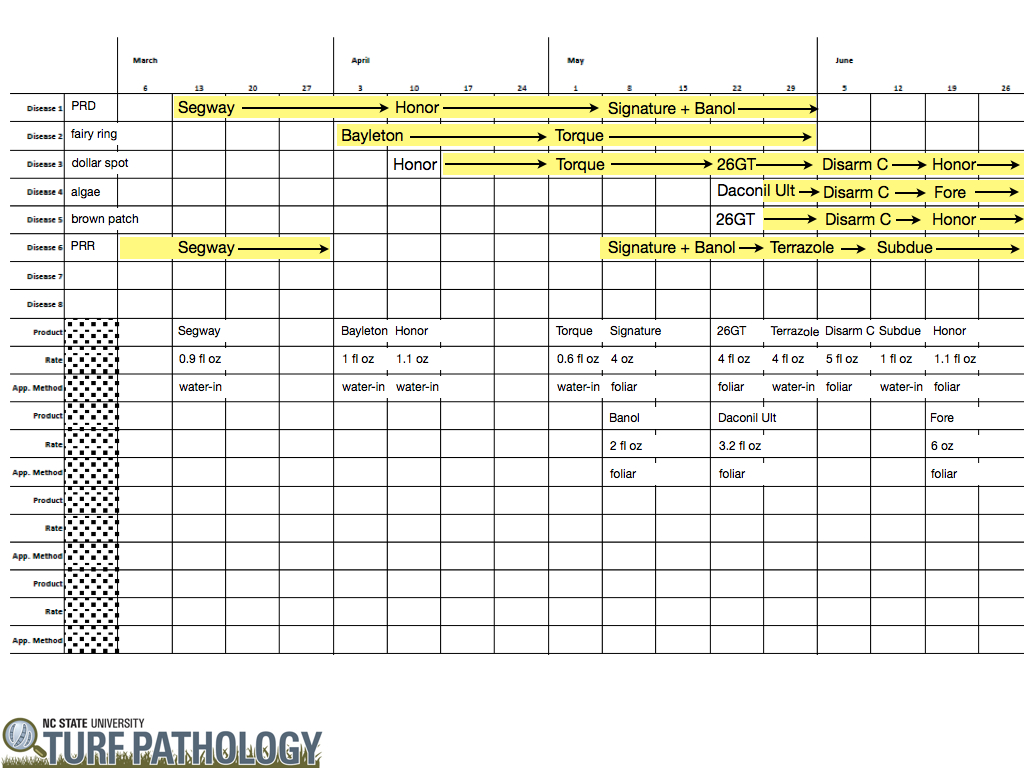
We used an excel spreadsheet to assist with developing the program. The diseases we need to control were listed at the top, with each column across the sheet corresponding to a week during the growing season. Using our knowledge of the weather conditions that trigger each disease and historical weather data from the State Climate Office of North Carolina, we highlighted the weeks that each disease is likely to be active. This gives you a good visual image of what diseases need to be controlled with each fungicide application. We used the Disease Management Utility on Turffiles to select a fungicide or tank-mixture that would control the diseases that are expected to be active during each week. We tried to avoid having to make fungicide applications on back-to-back weeks, but in several cases we needed to do that because application methods (foliar vs. watered-in) were not compatible.

Here's the program we came up with:

March 14:  Segway (0.9 fl oz, watered-in)
April 4:  Bayleton (1 fl oz, watered-in)
April 11:  Honor (1.1 oz, watered-in)
May 2:  Torque (0.6 fl oz, watered-in)
May 9:  Signature + Banol (4 oz + 2 fl oz)
May 23:  26GT + Fore (4 fl oz + 6 oz)
May 30:  Terrazole (4 oz, watered-in)
June 6:  Disarm C (5 fl oz)
June 13:  Subdue Maxx (1 fl oz, watered-in)
June 20:  Honor + Fore (1.1 oz + 6 oz)
July 5:  Signature + Daconil Ultrex (4 oz + 3.2 oz)
July 11:  Segway (0.9 fl oz, watered-in)
July 18:  Disarm C (5 fl oz)
Aug 1:  Stellar + Daconil Ultrex (1.2 fl oz + 3.2 oz)
Aug 15: Spectro + Alude (5.76 oz + 6 fl oz)
Aug 29:  Subdue Maxx + Fore (1 fl oz + 6 oz)
Sept 12:  Reserve (3.2 fl oz)
Sept 26:  26GT + Daconil Ultrex (4 fl oz + 3.2 oz)

If this seems like a lot of applications and an expensive program, you're absolutely right. Several of these applications are specifically to control Pythium root rot, which can develop any time between May and October in North Carolina depending on when the wet weather comes. This is why adjusting your fungicide program based on the current conditions is so important - many of these Pythium applications could be avoided if the weather is dry and unfavorable for Pythium root rot development at that time.

This year we'll be comparing this NC State program to other common fungicide programs, and one that we adjust on the fly based on the current weather conditions, to see which method provides the best disease control and highest turf quality. 

For more information about our Program '11 Project, or to follow along on Facebook or Twitter, please visit our website turfpathology.org.

Friday, April 15, 2011

Program '11: Develop a fungicide program in 4 easy steps

Designing a fungicide program for golf course putting greens is a daunting task, even for the most experienced golf course superintendent. There are many factors to consider, and at times it seems too many products to choose from. However, I think it becomes a lot easier if you break it down into 4 easy steps:
  1. Which diseases do I need to prevent? It should seem obvious that developing a good fungicide program is impossible without first answering this question. You need to know which diseases you're trying to control in order to design a good program! Yet, it is not uncommon for superintendents to skip this step or get it wrong. For example, I see a lot of superintendents throughout NC spraying unnecessarily for take-all patch, which is only a problem at high elevations in the western part of the state. On the other hand, a lot of people with older bentgrass varieties like Pencross, Pennlinks, Dominant, Crenshaw, and L-93 do not treat their greens for anthracnose, which is a common problem on these varieties.
  2. What weather conditions trigger development of these diseases? Now that you've selected the diseases you need to control, it's time to become familiar with the conditions that trigger their development. Each disease develops under a specific set of conditions, whether it be a range in soil temperatures, night temperatures above a certain threshold, or other factors. These conditions, to the best of our knowledge, are explained in detail in our disease profiles. Take the time to become familiar with the diseases you need to control and what conditions favor their development.
  3. When can I expect these diseases to be active in my location? Weather conditions vary widely across a state like North Carolina, so it's not possible for us to develop a blanket recommendation for application timing that everyone can follow. Fortunately, the State Climate Office of North Carolina has 30-year average climate data for a number of weather stations across the state, which are easily accessible on their website. Using this historical weather data, you can pinpoint the approximate date on which diseases will tend to become active. For example, looking at the historical data from Raleigh, night temperatures tend to rise above 50F on May 1. For root diseases, use average daily air temperature to estimate soil temperature. For example, average air temperatures reach 55F on about April 7, so this would be the time to start preventing fairy ring.
  4. Which product or products will control all of the diseases I need to prevent? This is still the hard part, but we've made it a lot easier by answering the first three questions. For every week during the growing season, we know which diseases are expected to be actively developing in the turf. Now all you need to do is work through the season, and for every week make sure that you are protected against those diseases. For this, you need an information source that ranks fungicides based on their effectiveness. The Disease Management Utility on TurfFiles was developed just for this purpose. This online decision aid allows you to select up to 5 diseases and it will return a list of fungicides ranked in order of their average effectiveness against the diseases you selected. Detailed information on each fungicide, including trade names, formulations, application rates, application intervals, and specific application instructions are also available on this system.
If you work your way through these steps, you should come out with a really solid program for your putting greens. Of course, every year is different, and it is important to adjust a program during the season as necessary, again using the conditions that favor your diseases as a guide. Next week, we'll take a look at the fungicide program that we developed using this system, and through this blog we'll keep you up to date on how we change it through the year. Stay tuned in one of the following ways!

Visit our website! turfpathology.org/pages/program11.aspx

Like us on Facebook: facebook.com/turfpathology

Follow us on Twitter: twitter.com/ncturfpathology

RSS Feed for Email or Google Reader: feeds.feedburner.com/turfpathology

Tuesday, March 29, 2011

Program '11: Lessons from 2010

The summer of 2010 was a rough one and an experience that nobody wants to repeat. While new problems like bacterial wilt received a lot of attention in 2010, in reality it was an old problem that caused the majority of damage to creeping bentgrass putting greens in North Carolina: Pythium root rot.


Pythium root rot is brought on by wet soil conditions; temperature doesn't matter. Since there are several Pythium species that can cause root rot, the disease can develop at any time of year as long as the soils are wet. We see Pythium root rot all throughout the year, and even diagnosed a case of it in western North Carolina last week.

Because it needs wet soils, Pythium root rot is most common in poorly drained greens. However, the disease can also occur in newer, well-drained greens if wet weather conditions persist for long enough. That's where spring of 2010 comes into play. Many areas in North Carolina experienced prolonged wet weather conditions during March and/or May, which triggered the development of Pythium root rot.

Our clinic was inundated with cases of Pythium root rot on creeping bentgrass during the first week of June. As soon as the weather turned hot, the plants with weakened, Pythium-infected roots were the first to decline. Most golf courses managed to survive through the initial heat wave in June, but hot and wet weather in July and August finished-off a lot of greens.

The problem is that most fungicide programs for creeping bentgrass greens include no fungicides for Pythium root rot until mid-June. Why wait until June? It's based on the misconception that Pythium diseases only develop during hot weather. We now know with 100% certainty that's not the case.


If you look at average daily rainfall in Raleigh, for example, you'll see that there is no pronounced wet season. Other than drier periods in April and late November, we get about 0.12 to 0.15" of precipitation per day on average from May through November. So when can we expect to see Pythium root rot activity? Any time between May and November, depending on when the rain comes in that particular year.

So what are you supposed to do, spray Pythium fungicides constantly from April through November? You could, but you'd be wasting a lot of money. The key is to adjust your fungicide program as needed during the year based on weather conditions: if it's wet, then treat the greens preventively for Pythium root rot. You simply can't write a Pythium root rot program on the calendar.

To find out more about Program '11, please visit our project website.

Monday, March 21, 2011

Introducing Program '11: The best fungicide program for your putting greens

Developing a fungicide program for putting greens is becoming increasingly complex, thanks mostly to an explosion in the number of products available to turf managers. When I came to NC State in 2002, I think there were about 60 different fungicide products available in the turf market. Now there are at least 120. It's enough to make your head spin.

It's little wonder that many golf course superintendents have gone toward 'canned' fungicide programs developed by university researchers or crop protection companies.

The problem with these programs is that every golf course is different. Just because a program works well on my research green in Raleigh doesn't mean it will work well on your greens. Different environments, microclimates, management practices, cultivars, construction methods, etc. - all of these things influence the potential for diseases to develop.

Furthermore, every year is different. The activity of a given disease can shift by a month or two depending on the weather conditions. Fungicide programs cannot be inked on the calendar and followed like a prescription. They have to be constantly tweaked and adjusted based on the hand that Mother Nature deals you.

So what is Program '11? This is a fungicide program that is specifically tailored for your putting greens, and adjusted for the specific conditions of 2011.

Over the next 6 months on this blog, we'll be chronicling a field experiment where we compare the performance of different fungicide programs, including one dubbed Program '11.  Program '11 was specifically designed for our research green and will be adjusted during the season based on the weather conditions. Along the way, we'll take a more detailed look at how you can develop and implement effective fungicide programs for your putting greens.

You can follow our progress in a number of ways -  choose one or all!

Visit our website! turfpathology.org/pages/program11.aspx

Like us on Facebook: facebook.com/turfpathology

Follow us on Twitter: twitter.com/ncturfpathology

RSS Feed for Email or Google Reader: feeds.feedburner.com/turfpathology