Showing posts with label turf. Show all posts

Monday, July 23, 2012

The Rundown


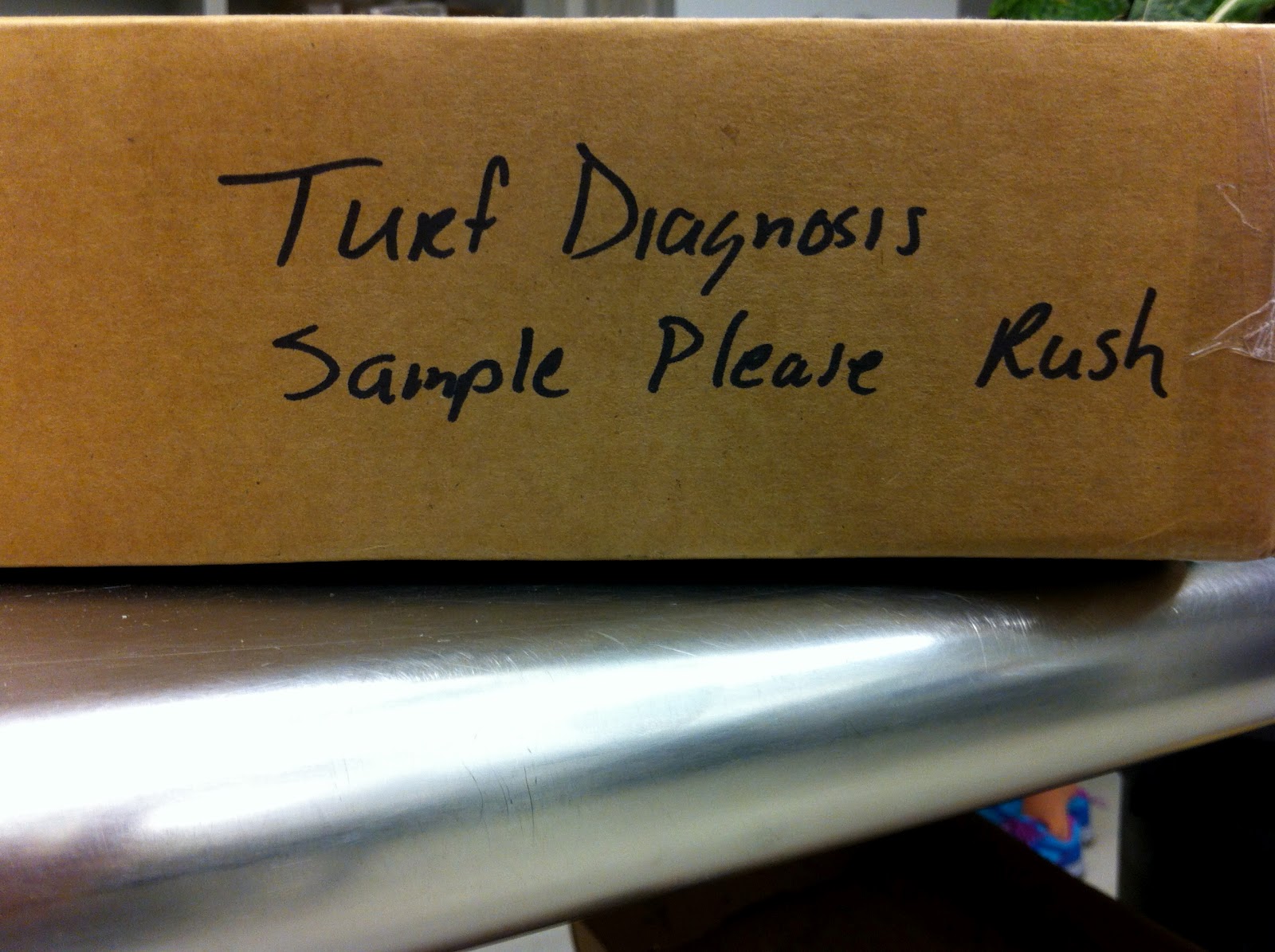
After a relatively quiet June at the NC State Turf Diagnostics Lab, turf samples have been rolling in during the month of July. Right after the record breaking heat wave experienced by North Carolina and much of the country, it seemed as if delivery trucks were backing up and dumping cardboard boxes of all shapes and sizes chocked full of ailing turfgrass samples.

One of the most common questions I get from golf course superintendents that I speak with on a weekly basis is "What are you seeing in the lab?" Well, here you go! Here's a rundown of the most common diagnoses we've made over the past two weeks.


Creeping Bentgrass Putting Greens
  1. Pythium root rot
  2. Fairy ring
  3. "Warm-weather" brown patch (Rhizoctonia zeae)
  4. Yellow spot
  5. Anthracnose

Home Lawns

Zoysiagrass
  1. Curvularia leaf spot
Bermudagrass
  1. Heat/drought stress
Tall Fescue
  1. Brown patch


Wednesday, June 20, 2012

Summer Solstice Welcomes Brown Patch

June is in full swing and so is brown patch in tall fescue lawns and landscapes.  Brown patch, caused by the fungus Rhizoctonia solani, is the most common disease in tall fescue during late spring and throughout the summer months in North Carolina.  Brown patch infections can start as early as April in some years with full blown outbreaks occurring by late May and early June in most years.  As the name implies, symptoms are brown to tan areas of turf that are roughly circular patches that range from a few inches to several feet in diameter.


Brown Patch Lesion on Tall Fescue Leaf


The two most common mistakes managers of tall fescue make are fertilizing too late or too much in late spring and over watering.  Tall fescue should not be fertilized after the first of May, unless you are using ultra low rates (< 0.25 lb N/M) with iron for a color effect.  The recommended amount of nitrogen on tall fescue per year is 3-4 pounds per 1,000 square feet.  Most people will apply a pound or two in the fall and a pound or two in the spring.  When in doubt, submit a soil test to ensure you're feeding your lawn the right nutrients at the correct amounts.

Watering should be done only as needed to prevent drought stress.  When you do apply irrigation, do it deep and infrequent instead of watering every day.  It is a common mistake for homeowners to set their irrigation system on a schedule and forget about it.  Remember, fungi love water and if you over water, you're giving the advantage to the fungi, not the turfgrass.  The ideal time to water your lawn is in the early morning hours before sunrise.  Irrigating during late afternoon or early evening is the worst thing you can do because this extends the leaf wetness period, however brown patch will love you for it!

Symptoms of Brown Patch in Tall Fescue

Need help knowing when and how much to water your lawn?  Try out our online water management tool at the following link.

http://turf-ims.ncsu.edu/

For more information about brown patch, including control recommendations, please visit the following link.


Wednesday, March 9, 2011

Is Emerald a poor curative for dollar spot control?


Over the years, I've heard a number of people say that Emerald is a slow or poor fungicide for curative control of dollar spot. I must confess that I've never understood what everyone is talking about.

Given that boscalid, the active ingredient in Emerald, controls fungi by depleting their energy reserves, it makes sense that it might be a little slow to work on a curative basis. However, in reality, I've always been impressed with it's activity on both a preventive and curative basis.


Let's look at a couple of examples. In this first curative dollar spot control study, we had an average of 40 to 45 dollar spot infection centers in each plot before initiation of treatments. That's not a huge amount of dollar spot on a 20 square foot plot, but certainly enough to warrant a curative fungicide application in a golf course setting.

On July 20, just 5 days after applying the low rate of Emerald, we reduced the number of infection centers down to 2 per plot, whereas the number in untreated plots held constant. So, the low rate of Emerald reduced dollar spot incidence by 95% in 5 days. I'd consider that to be pretty good curative activity! If you're expecting more than this out of a curative application, then you are probably expecting too much.


Looking at some older data, in 2006 we evaluated Emerald, Daconil + Emerald, and Daconil + Banner for curative dollar spot control. In this case, the dollar spot pressure was much more intense, with 150 to 200 dollar spot infection centers per plot before the initiation of treatments. After the first application on 19 Jun, dollar spot incidence declined in all of the treatments at a similar rate and none of the treatments were disease free until three weeks later on 10 Jul. And this is even though dollar spot disease pressure was much lower during late June and early July, as evidenced by the decline in the amount of disease in untreated plots.

Curative control of any disease is more dependent on the level of disease pressure, the amount of turf injury present, and the growth rate of the turf after the application. Which fungicide is applied probably isn't that important in most cases. In order for the disease symptoms to go away, the turf has to grow out of the symptoms and spread into the damaged areas. This, of course, takes time. There aren't any fungicides that will make dollar spot go away over night.

For a lot of reasons, we don't recommend controlling dollar spot on a curative basis. Perhaps the most important reason is that curative applications increase the risk for fungicide resistance to develop. If you find yourself in a situation where you need to make a curative application for dollar spot control, be sure that you are tank-mixing with chlorothalonil to reduce the potential for resistance to develop. This is especially important for products with a high resistance risk like Emerald.

Monday, February 7, 2011

Watch out for yellow patch on putting greens and landscapes

Yellow patch on an annual bluegrass putting green
Given the cool, wet weather we've had over the last few weeks, golf course superintendents should be on the lookout for yellow patch in their creeping bentgrass putting greens. This disease is also known as 'cool-season brown patch', but the symptoms are very different. Yellow patch appears in irregular rings and arcs that are yellow, or sometimes white. Some people say it looks just like sweat rings on an old baseball cap.

Yellow patch can also occur in landscapes established with Kentucky bluegrass or tall fescue. In these cases, the rings are not so distinct but instead has a very irregular appearance. Distinct lesions that are white or light tan with a light brown border can be seen on the affected leaves.

Yellow patch in a Kentucky bluegrass landscape
Yellow patch can be controlled easily with fungicides, but recovery can be slow if the turf is not growing due to cool temperatures. Early detection and treatment is very important for this reason.

Refer to the Disease Management Utility on TurfFiles for a list of recommended fungicides for yellow patch control.