Showing posts with label diagnosis. Show all posts

Thursday, August 1, 2013

What Disease?

If I had a wooden nickel for every time someone has said the following to me in the past few weeks, I'd be able to build a raging fire ... "I bet you are swamped with samples in the clinic right now with all the rain we've had, etc. etc., etc." Actually, outside of a few oddball cases, we haven't seen or heard of any major disease problems on creeping bentgrass putting greens. The missing link has been heat stress. If we look back at our records, some of our busiest years have been those that were hotter and drier which ultimately leads to more stress on the plant therefore making them weaker and more susceptible to infection by pathogens.

One of the oddball cases we have diagnosed in the past couple weeks has been summer patch on creeping bentgrass putting greens. The symptoms of summer patch appear as circular patches or rings, ranging from 6 inches to 3 feet in diameter. Turf within these patches initially turns off-colored, is prone to wilt, grows poorly, and may appear sunken in the turf stand. Over a period of a few weeks, the turf continues to decline, turns yellow or straw brown and eventually collapses to the soil surface. The outer edges of the patch are usually orange or bronze when the disease is actively developing. The patches recur in the same spot annually, and can expand at a rate of 2 to 4 inches per year.

Summer patch symptoms on creeping bentgrass


The summer patch fungus attacks the roots, stolons, and rhizomes in the spring when soil temperatures reach 65°F. Summer patch symptoms are rarely seen during the early stages of disease development, instead, the symptoms appear in mid-summer after considerable damage has been done to the root system. Heat, drought stress, and nutrient deficiencies are the main factors that encourage the expression of summer patch symptoms. In North Carolina, the symptoms typically appear in early to mid-July.

For more information about summer patch, including control recommendations, click here.

Finally, if any of you are wondering about Pythium root rot, we have only diagnosed a handful of cases thus far with all of those happening within the past 7-10 days. In every case, we have found the Pythium to be active in the upper thatch layer around roots closest to the plant. With that being said, if you are treating for Pythium root rot, don't water those fungicides in TOO much. We typically recommend about an 1/8" ... which in most cases equals about 3-4 minutes with part circle heads. Either way, you may want to take the time to see just how long it takes to put that amount out.

Pythium root rot following drainage route

For more information about Pythium root rot, including control recommendations, click here.


Monday, July 23, 2012

The Rundown


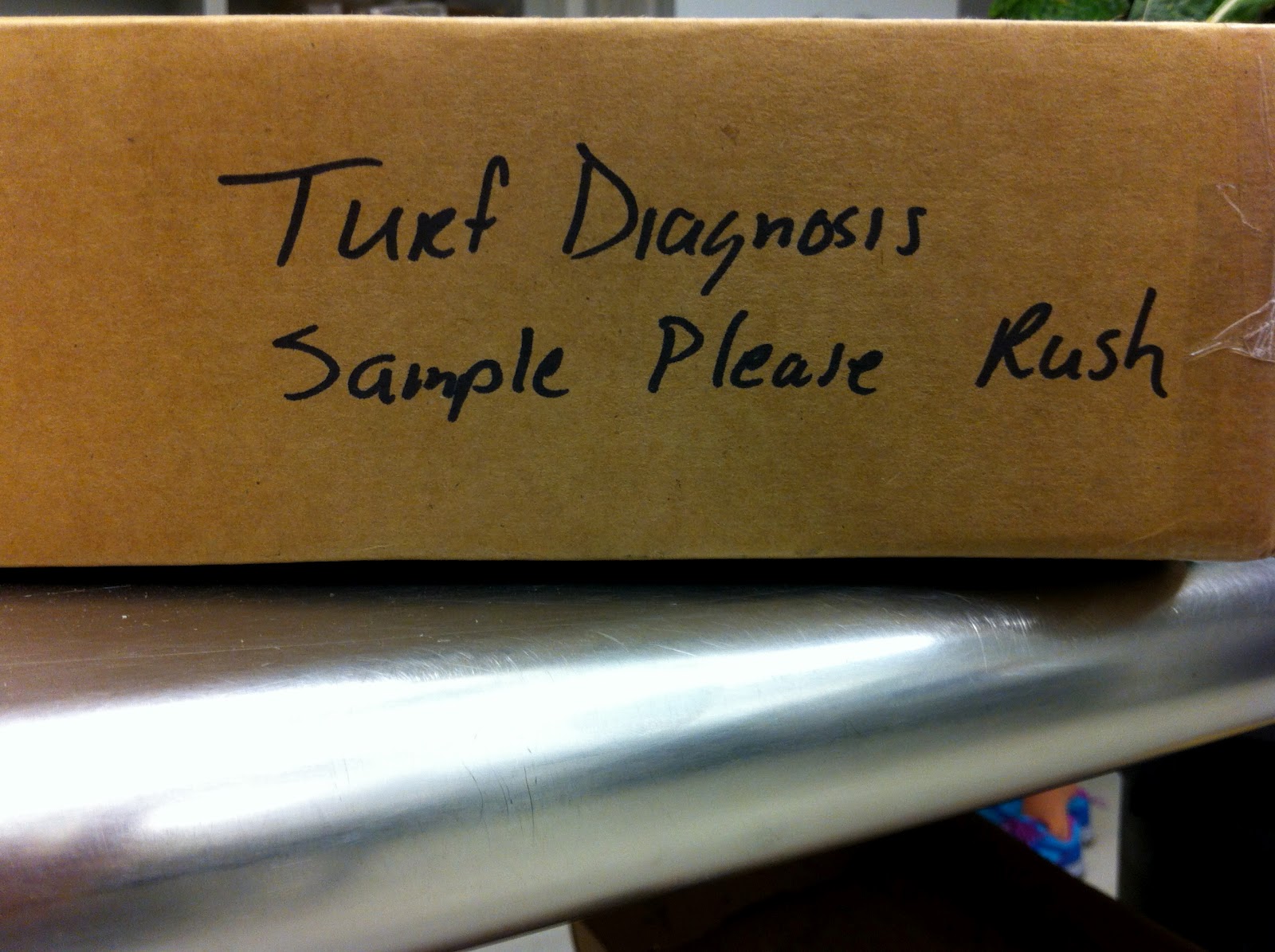
After a relatively quiet June at the NC State Turf Diagnostics Lab, turf samples have been rolling in during the month of July. Right after the record breaking heat wave experienced by North Carolina and much of the country, it seemed as if delivery trucks were backing up and dumping cardboard boxes of all shapes and sizes chocked full of ailing turfgrass samples.

One of the most common questions I get from golf course superintendents that I speak with on a weekly basis is "What are you seeing in the lab?" Well, here you go! Here's a rundown of the most common diagnoses we've made over the past two weeks.


Creeping Bentgrass Putting Greens
  1. Pythium root rot
  2. Fairy ring
  3. "Warm-weather" brown patch (Rhizoctonia zeae)
  4. Yellow spot
  5. Anthracnose

Home Lawns

Zoysiagrass
  1. Curvularia leaf spot
Bermudagrass
  1. Heat/drought stress
Tall Fescue
  1. Brown patch


Wednesday, October 26, 2011

Pythium blight of bermudagrass putting greens

Following recent periods of wet, cloudy weather we've had several reports of a disease appearing on bermudagrass putting greens. The symptoms are a rapid foliar blight that initially has a purple coloration but then fades to tan. Spread on mowers or in drainage patterns usually occurs as well. Many superintendents assume that this is leaf spot, which of course is a common bermudagrass disease during wet weather in the fall. I have to admit that the first time I saw this I also thought it was leaf spot. But I was wrong - it is Pythium blight.


Pythium blight in October? Yes, you read it correctly, it is Pythium blight in October.

There are a lot of Pythium species that can infect grasses. Most people are familiar with P. aphanidermatum that causes Pythium blight on the cool season grasses during hot summer weather. However, there are other Pythium species that grow during cool or cold weather. We don't know what species is causing this outbreak yet, but obviously it grows well during cool weather and has a competitive advantage over the bermudagrass under these conditions.

Fungicide treatments may not always be necessary to control Pythium blight on bermudagrass, as dry and sunny weather usually put a stop to it very quickly. However, if the forecast is calling for extended periods of wet and cloudy weather, an application might be a good idea. Any strong Pythium fungicide should do a good job.

Friday, June 24, 2011

If it's yellow, just be mellow

Rumors have been swirling around the golf industry over the last week about 'bacterial wilt'. For the record, I want to make it clear that we have diagnosed NO cases of bacterial wilt in North Carolina or any other state.

I repeat, we have diagnosed NO cases of bacterial wilt in North Carolina or any other state.

Yellow spot of creeping bentgrass.
We have seen suspicious amounts of bacteria in bentgrass expressing symptoms of yellowing, etiolation, and gradual thinning. We don't know if these bacteria are the cause of the problem or if they are a secondary invader. As a result, we don't know if this is an actual disease or not. For more information, see our recent blog post.

A severe case of yellow spot on creeping bentgrass.
'Bacterial wilt' is caused by Xanthomonas translucens and is primarily a problem on Poa annua but also occurred on 'Toronto' creeping bentgrass back in the 1980s. Bacterial wilt causes rapid wilting and dieback of infected plants. Chlorosis, etiolation, and slow thinning of the turf doesn't fit the description of this disease. Therefore, what we are seeing now is NOT bacterial wilt.

We've had countless calls and samples over the last week from superintendents who fear they have bacterial wilt because they are seeing chlorotic or yellow turf. It's important to realize that many things can cause turf to turn yellow, and that if you aren't seeing the etiolation and gradual thinning then you probably don't have this suspected bacterial problem. For more information about some of the most common reasons for yellowing turf, please refer to this post on turfdiseases.org.

Several of the samples that came into our clinic this week turned out to be yellow spot. This disease causes chlorotic spots and patches on creeping bentgrass putting greens, but does not cause an abnormal growth habit and we've never seen it lead to thinning of the turf.

Yellow spot symptoms are especially prevalent during dry and hot weather. That certainly fits the conditions we're experiencing in North Carolina right now. For more information about yellow spot, please refer to this Golf Course Management article from the November 2006 issue.

Thursday, June 16, 2011

Suspected Bacterial Disease of Creeping Bentgrass


Over the last two weeks, the Turf Diagnostics Lab at NC State received several samples of a suspected bacterial disease on bentgrass putting greens. All of the affected golf courses have been in the Piedmont region, from Raleigh to Greensboro to Charlotte.


Most locations are reporting yellowing and etiolation of the bentgrass followed by a slow thinning. The symptoms are relatively mild in these locations. Two courses experienced a more rapid and widespread decline. In all cases, the symptoms are limited to areas that were severely damaged last year by heat stress or other diseases.

We are working to isolate and identify the bacteria associated with these samples. Since there are bacteria in almost every turf sample we receive, we need to determine if the bacteria are pathogenic before we can be sure that they are the cause of the problem.

In the meantime, golf course superintendents who are seeing these symptoms are advised to avoid abrasive practices like aerification, verticutting, and topdressing. If the symptoms are localized to cleanup passes or certain greens, then dedicate a mower to those areas or wash the mower thoroughly and spray it with a 10% bleach solution before moving to other greens. Mowing affected areas last after the dew has dried or spraying with a hydrogen peroxide solution before mowing may also help to minimize the spread of bacteria.

In addition, anything that can be done to minimize stress on the turf is advised; for example raising mowing heights, switching to solid rollers, or skipping mowings on affected areas.

We are investing all of our effort and resources into determining the cause of this problem and developing a practical solution. We have initiated trials at 4 golf courses to evaluate practices that may help to control it. Be sure to follow our blog or sign up for email alerts to receive regular updates:

Like us on Facebook: facebook.com/turfpathology

Follow us on Twitter: twitter.com/ncturfpathology

Receive alerts by email: feeds.feedburner.com/turfpathology

Monday, February 7, 2011

How to submit a sample to the Turf Diagnostics Lab

This video will show you how to collect and submit a sample to the NC State Turf Diagnostics Lab for disease diagnosis.