Tuesday, April 19, 2011

Speeding the recovery from spring dead spot


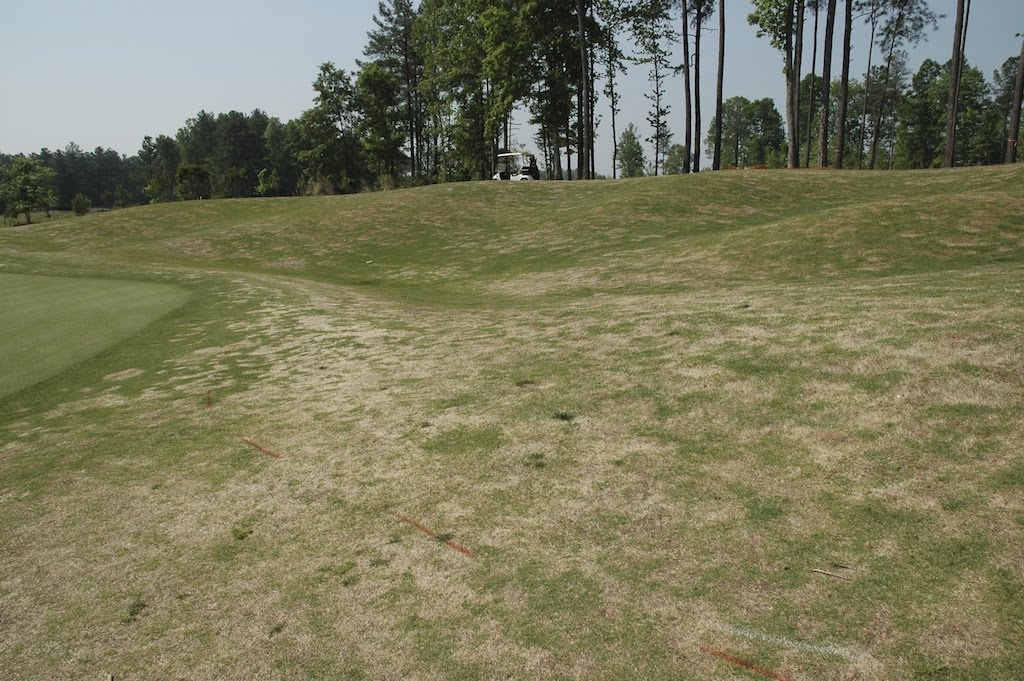
From what I've seen and heard, spring dead spot is particularly severe this year, which isn't a surprise given the cold winter with alternating wet and dry periods. These types of conditions are ideal for spring dead spot.

Unfortunately, there is nothing you can do in the spring to control spring dead spot. The pathogen does its damage in the fall and early winter, which causes the turf to be more susceptible to freezing injury. Even though you see the symptoms now, the disease isn't actively developing at this time.

The best you can do is to take steps to speed the bermudagrass recovery from the spring dead spot symptoms. Recovery from spring dead spot occurs primarily through the spread of stolons into the patch from the outside. There are several ways this can be accelerated:

1. Avoid use of DNA herbicides, like prodiamine, for pre-emergence control of crabgrass and other annual grasses. These herbicides inhibit turf root growth and will prevent the bermudagrass stolons from rooting as they spread into the patch from the outside. Oxadiazon is recommended instead because it does not inhibit root growth.

2. Break up the layer of dead turf in the spring dead spot patches through spiking or hollow-tine aerification. Roots emerging from the bermudagrass stolons cannot penetrate through this layer of dead turf to reach the soil below. Just like a grow-in situation, you need to establish good stolon-soil contact.

3. Apply fertilizer and irrigation in light and frequent doses, again mimicking a grow-in situation, to encourage growth of the poorly-rooted stolons. Note that the total amount of fertilization should not be increased, as any excess residual nitrogen remaining in the fall could exacerbate the disease.

For more information about spring dead spot, please see our spring dead spot disease profile.

Friday, April 15, 2011

Program '11: Develop a fungicide program in 4 easy steps

Designing a fungicide program for golf course putting greens is a daunting task, even for the most experienced golf course superintendent. There are many factors to consider, and at times it seems too many products to choose from. However, I think it becomes a lot easier if you break it down into 4 easy steps:
  1. Which diseases do I need to prevent? It should seem obvious that developing a good fungicide program is impossible without first answering this question. You need to know which diseases you're trying to control in order to design a good program! Yet, it is not uncommon for superintendents to skip this step or get it wrong. For example, I see a lot of superintendents throughout NC spraying unnecessarily for take-all patch, which is only a problem at high elevations in the western part of the state. On the other hand, a lot of people with older bentgrass varieties like Pencross, Pennlinks, Dominant, Crenshaw, and L-93 do not treat their greens for anthracnose, which is a common problem on these varieties.
  2. What weather conditions trigger development of these diseases? Now that you've selected the diseases you need to control, it's time to become familiar with the conditions that trigger their development. Each disease develops under a specific set of conditions, whether it be a range in soil temperatures, night temperatures above a certain threshold, or other factors. These conditions, to the best of our knowledge, are explained in detail in our disease profiles. Take the time to become familiar with the diseases you need to control and what conditions favor their development.
  3. When can I expect these diseases to be active in my location? Weather conditions vary widely across a state like North Carolina, so it's not possible for us to develop a blanket recommendation for application timing that everyone can follow. Fortunately, the State Climate Office of North Carolina has 30-year average climate data for a number of weather stations across the state, which are easily accessible on their website. Using this historical weather data, you can pinpoint the approximate date on which diseases will tend to become active. For example, looking at the historical data from Raleigh, night temperatures tend to rise above 50F on May 1. For root diseases, use average daily air temperature to estimate soil temperature. For example, average air temperatures reach 55F on about April 7, so this would be the time to start preventing fairy ring.
  4. Which product or products will control all of the diseases I need to prevent? This is still the hard part, but we've made it a lot easier by answering the first three questions. For every week during the growing season, we know which diseases are expected to be actively developing in the turf. Now all you need to do is work through the season, and for every week make sure that you are protected against those diseases. For this, you need an information source that ranks fungicides based on their effectiveness. The Disease Management Utility on TurfFiles was developed just for this purpose. This online decision aid allows you to select up to 5 diseases and it will return a list of fungicides ranked in order of their average effectiveness against the diseases you selected. Detailed information on each fungicide, including trade names, formulations, application rates, application intervals, and specific application instructions are also available on this system.
If you work your way through these steps, you should come out with a really solid program for your putting greens. Of course, every year is different, and it is important to adjust a program during the season as necessary, again using the conditions that favor your diseases as a guide. Next week, we'll take a look at the fungicide program that we developed using this system, and through this blog we'll keep you up to date on how we change it through the year. Stay tuned in one of the following ways!

Visit our website! turfpathology.org/pages/program11.aspx

Like us on Facebook: facebook.com/turfpathology

Follow us on Twitter: twitter.com/ncturfpathology

RSS Feed for Email or Google Reader: feeds.feedburner.com/turfpathology

Tuesday, April 12, 2011

Spring rings on MiniVerde greens


We don't have a whole lot of MiniVerde in North Carolina yet, but we've had several reports of widespread rings appearing on MiniVerde greens as they are greening up this spring. Interestingly, we haven't had similar reports from superintendents with Champion or Tifeagle greens.

The rings on MiniVerde are typically about 1 foot in diameter and are very irregular in shape, not perfectly circular. The turf on the outer edge has a yellow or reddish-brown cast to it.

Any time we see this type of spring symptom on warm-season grasses, we automatically think that it is large patch caused by Rhizoctonia solani. Based on our initial look at samples, it is definitely a Rhizoctonia disease, but we are isolating to confirm exactly which species is the culprit.

Either way, recovery should be very quick once sunlight and warm temperatures come and the bermudagrass starts growing aggressively. In fact, two superintendents reported that the symptoms have already become less noticeable as the bermudagrass continued to green up.

A fungicide application probably isn't necessary, but could help to speed up the recovery process if the symptoms are very severe or widespread. Any systemic Rhizoctonia fungicide, such as azoxystrobin, flutolanil, or fluoxastrobin should provide good control. Check out the Disease Management Utility for a complete list of products labeled for large patch control.

Tuesday, March 29, 2011

Program '11: Lessons from 2010

The summer of 2010 was a rough one and an experience that nobody wants to repeat. While new problems like bacterial wilt received a lot of attention in 2010, in reality it was an old problem that caused the majority of damage to creeping bentgrass putting greens in North Carolina: Pythium root rot.


Pythium root rot is brought on by wet soil conditions; temperature doesn't matter. Since there are several Pythium species that can cause root rot, the disease can develop at any time of year as long as the soils are wet. We see Pythium root rot all throughout the year, and even diagnosed a case of it in western North Carolina last week.

Because it needs wet soils, Pythium root rot is most common in poorly drained greens. However, the disease can also occur in newer, well-drained greens if wet weather conditions persist for long enough. That's where spring of 2010 comes into play. Many areas in North Carolina experienced prolonged wet weather conditions during March and/or May, which triggered the development of Pythium root rot.

Our clinic was inundated with cases of Pythium root rot on creeping bentgrass during the first week of June. As soon as the weather turned hot, the plants with weakened, Pythium-infected roots were the first to decline. Most golf courses managed to survive through the initial heat wave in June, but hot and wet weather in July and August finished-off a lot of greens.

The problem is that most fungicide programs for creeping bentgrass greens include no fungicides for Pythium root rot until mid-June. Why wait until June? It's based on the misconception that Pythium diseases only develop during hot weather. We now know with 100% certainty that's not the case.


If you look at average daily rainfall in Raleigh, for example, you'll see that there is no pronounced wet season. Other than drier periods in April and late November, we get about 0.12 to 0.15" of precipitation per day on average from May through November. So when can we expect to see Pythium root rot activity? Any time between May and November, depending on when the rain comes in that particular year.

So what are you supposed to do, spray Pythium fungicides constantly from April through November? You could, but you'd be wasting a lot of money. The key is to adjust your fungicide program as needed during the year based on weather conditions: if it's wet, then treat the greens preventively for Pythium root rot. You simply can't write a Pythium root rot program on the calendar.

To find out more about Program '11, please visit our project website.

Thursday, March 24, 2011

Pythium Root Dysfunction Alert


Multiple cases of Pythium root dysfunction, caused by Pythium volutum, have been confirmed in our lab from golf courses with creeping bentgrass putting greens throughout the Piedmont and Coastal Plains of North Carolina. The warmer than usual weather conditions have warmed the soil temperatures well into the optimum range for PRD development.

If you've had problems with PRD in the past, then you should have already started your preventative program. Don't worry if you haven't, there's still time to correct this issue before summer arrives. Remember, this is a ROOT DISEASE, therefore you must WATER-IN your fungicide applications to be successful!

For more information about PRD, including specific control recommendations, click here.

Monday, March 21, 2011

Introducing Program '11: The best fungicide program for your putting greens

Developing a fungicide program for putting greens is becoming increasingly complex, thanks mostly to an explosion in the number of products available to turf managers. When I came to NC State in 2002, I think there were about 60 different fungicide products available in the turf market. Now there are at least 120. It's enough to make your head spin.

It's little wonder that many golf course superintendents have gone toward 'canned' fungicide programs developed by university researchers or crop protection companies.

The problem with these programs is that every golf course is different. Just because a program works well on my research green in Raleigh doesn't mean it will work well on your greens. Different environments, microclimates, management practices, cultivars, construction methods, etc. - all of these things influence the potential for diseases to develop.

Furthermore, every year is different. The activity of a given disease can shift by a month or two depending on the weather conditions. Fungicide programs cannot be inked on the calendar and followed like a prescription. They have to be constantly tweaked and adjusted based on the hand that Mother Nature deals you.

So what is Program '11? This is a fungicide program that is specifically tailored for your putting greens, and adjusted for the specific conditions of 2011.

Over the next 6 months on this blog, we'll be chronicling a field experiment where we compare the performance of different fungicide programs, including one dubbed Program '11.  Program '11 was specifically designed for our research green and will be adjusted during the season based on the weather conditions. Along the way, we'll take a more detailed look at how you can develop and implement effective fungicide programs for your putting greens.

You can follow our progress in a number of ways -  choose one or all!

Visit our website! turfpathology.org/pages/program11.aspx

Like us on Facebook: facebook.com/turfpathology

Follow us on Twitter: twitter.com/ncturfpathology

RSS Feed for Email or Google Reader: feeds.feedburner.com/turfpathology

Friday, March 18, 2011

Hit two birds with one stone using the DMIs

Although it's not yet officially spring, temperatures across North Carolina are becoming conducive to two common spring diseases: dollar spot and fairy ring. Now's the best time to initiate preventive fungicide programs for these diseases.

The dollar spot pathogen becomes active when low temperatures are consistently above 50ºF, especially when combined with heavy dew formation during the night. Looking at the forecast for the next week, low temperatures will remain in the low- to mid-50s for about another week in Wilmington, Raleigh, Greensboro, and Charlotte.

For greens established with creeping bentgrass, we recommend initiating preventive fungicide treatments for fairy ring when 5-day average soil temperature reaches 55ºF. Most of North Carolina will be hitting that mark over the next week as well.


Our recent research shows that the DMI fungicides, like Bayleton, Torque, Tourney, and Triton, are very effective for fairy ring prevention. These treatments, even though they are watered into the soil, will also provide excellent dollar spot control because the DMIs are translocated upward in the plant. So, in the current environment where everyone is looking to save money, the DMIs are an excellent way to control both dollar spot and fairy ring with one application!

For more information, please visit our disease profiles on dollar spot and fairy ring, or the Disease Management Utility for assistance in selecting a fungicide and application rate.