The annual NC Western Turf Conference is nearly a week away on Tuesday March 12, 2013. The conference will be held at the Virginia C. Boone Mountain Heritage Building at the Western North Carolina Agricultural Center in Fletcher, NC. There will be a wide variety of presentations on golf course, home lawn, and athletic field management. Registration and event information can be found here
Western Turf Conference Info
In addition to presentations on insect and weed management, the turf pathology group will be discussing anthracnose and bacterial disease on putting greens, maximizing fungicide performance, and managing diseases in home lawns and athletic fields.

Monday, March 4, 2013
Wednesday, January 30, 2013
Winter Patch Diseases Now Flocking!
Recent weather patterns, as weird as they may be, have been favorable for two common winter time diseases to start showing up across portions of North Carolina. They are Microdochium patch (a.k.a. pink snow mold) and yellow patch (cool weather brown patch).
As most of you know, Microdochium patch doesn't require snow cover and isn't necessarily pink in color, although if you look at the picture below, you can see that the mycelium does indeed have a pinkish tone. Infection areas may start out as small as 2" in diameter and expand up to 12" over time. The leading edge of the patch may have a reddish brown or salmon color and the leaves in the middle will be collapsed and matted upon themselves. Also, this fungus is a heavy spore producer, so the damage may appear as if it has been spread or smeared by mowers, equipment, water, etc.
For more information about Microdochium patch, including control recommendations, click here.
Yellow patch is a very common disease of cool season turfgrasses this time of year and typically causes irregular patches up to 3 feet in diameter that are yellow in color. On creeping bentgrass putting greens and other lower cut turfgrasses, it reminds me of sweat rings in an old ball cap.
For more information about yellow patch, including control recommendations, click here.
As most of you know, Microdochium patch doesn't require snow cover and isn't necessarily pink in color, although if you look at the picture below, you can see that the mycelium does indeed have a pinkish tone. Infection areas may start out as small as 2" in diameter and expand up to 12" over time. The leading edge of the patch may have a reddish brown or salmon color and the leaves in the middle will be collapsed and matted upon themselves. Also, this fungus is a heavy spore producer, so the damage may appear as if it has been spread or smeared by mowers, equipment, water, etc.
For more information about Microdochium patch, including control recommendations, click here.
 |
| Pinkish Flock of Microdochium Mycelium |
 |
| Microdochium Patch |
 |
| Microdochium Patch |
Yellow patch is a very common disease of cool season turfgrasses this time of year and typically causes irregular patches up to 3 feet in diameter that are yellow in color. On creeping bentgrass putting greens and other lower cut turfgrasses, it reminds me of sweat rings in an old ball cap.
For more information about yellow patch, including control recommendations, click here.
 |
| Yellow Patch on Creeping Bentgrass |
 |
| Yellow Patch on Ryegrass |

Wednesday, September 26, 2012
Coming in Jan 2013: Dr. Jim Kerns!

Recently the department of plant pathology at NC State University graciously offered me the turfgrass pathology position. Turfgrass Pathology has a long, storied history dating back to Dr. L.T. Lucas. Many may know that I have a small part in the history of turfgrass pathology at NC State. I had the great pleasure to have Dr. Lane Tredway as my major advisor during my PhD while I was at NC State. There is no doubt that Lane built a Ferrari of a program and I am very much looking forward to driving this Ferrari. Undoubtedly I will drive this program in a different direction, but I assure you I will do everything I can to provide value and service to the turfgrass industry of North Carolina.
For the last 4.5 years I have built a program in turfgrass pathology at the University of Wisconsin-Madison. While there my program focused on diseases of cool-season turfgrass and in particular, dollar spot and snow molds. I built many great relationships in Wisconsin and I will miss working with the great industry there. This is a huge change moving from Wisconsin back to North Carolina and I will likely require an education from you all on what is important to you. I am very much looking forward to working with all of you and seeing what we can accomplish together. My official start date will likely be in early Janaury 2013. Prior to this, I am happy to discuss research ideas or areas of need and I have listed my current contact information below.
Jim Kerns
(608) 516-8917
jkerns0@gmail.com
Wednesday, September 19, 2012
Treat for Large Patch Now!
With soil temperatures starting to approach 70°F across portions of NC, now is the time to start thinking about treating for large patch.
 |
| Average Daily Soil Temperatures as of 9/18/12 via NC State Climate Office |
Large patch, which is caused by the fungus Rhizoctonia solani, is a common disease of centipedegrass, St. Augustinegrass, zoysiagrass, and bermudagrass grown for lawns, landscapes, golf turf, and athletic fields. Centipedegrass and St. Augustinegrass are particularly susceptible to this disease.
Symptoms of large patch appear in roughly circular patches from 2 feet up to 10 feet or more in diameter. The affected turf will initially be orange, yellow, or reddish-brown in color but will then turn tan and collapse to the ground. The disease can spread rapidly to encompass large areas of turf, and distinct circular patches may not be obvious in these cases.
Fungicides are available for large patch control, but they must be applied preventatively for best results. The first application should be made in the late summer or early fall when average daily soil temperatures are 70°F or below.
One fungicide application will control minor cases of large patch, but two to three applications on a 4 to 6 week interval may be needed to control severe cases. Fungicides are not very effective once the symptoms of large patch appear. Curative applications will help to reduce further spread of the disease, but the affected turf will be very slow to recover.
Click here for more information about Large Patch, including images and specific control recommendations.
Monday, September 17, 2012
Treat for Spring Dead Spot Now!
So, your first question may be "Why on Earth are you telling me to apply fungicides for a spring disease in the fall and for something that will not show up for another 6-7 months?!" The answer is simple. The causal fungus, Ophiosphaerella spp., is active RIGHT NOW and you can bet it's infecting your bermuda and zoysia grass plants as I type this blog. We know through years of research that fungicides are most effective when the soil temperatures are between 60 - 80°F in the fall of the year.

As you can see by the map above, the time is right for preventative applications. However, choosing the right fungicide and applying at the right time will not result in acceptable levels of control if you do not apply them correctly. Spring dead spot infects below ground plant parts. With that being said, you must either water-in your fungicide applications IMMEDIATELY with 1/4" of irrigation or apply with a carrier volume of 5 gal/water/1,000 sq. ft. You need to be running your irrigation the moment the applicator is out of the way. Do not wait until the following evening or night with your routine irrigation schedule or else you may be severely disappointed come next spring when these grasses green back up.
Just recently we have made some fantastic discoveries with fertilizers in regards to controlling this disease without having to use fungicides at all! To learn more about this, please click here.
Also, if you haven't heard, Rubigan will be coming off the market in December of 2012. Rubigan is one of the better fungicides available for spring dead spot control. To learn more about this, click here.
To learn much more about spring dead spot, including control recommendations and images, please click here.
Just recently we have made some fantastic discoveries with fertilizers in regards to controlling this disease without having to use fungicides at all! To learn more about this, please click here.
Also, if you haven't heard, Rubigan will be coming off the market in December of 2012. Rubigan is one of the better fungicides available for spring dead spot control. To learn more about this, click here.
To learn much more about spring dead spot, including control recommendations and images, please click here.
Friday, August 24, 2012
15 Minutes of Fame for Leaf Spot
After looking back through prior alerts and posts, I discovered that leaf spot diseases have never made the cut, until now. Recent weather patterns of cloudy and rainy weather across much of North Carolina have been perfect for foliar diseases such as Bipolaris leaf spot and gray leaf spot.
 |
| Bipolaris Leaf Spot on Bermudagrass |
We have received several samples of bermudagrass in the past week that were devastated by the fungus Bipolaris cynodontis. Bipolaris leaf spot is most severe on turf that is growing slowly due to adverse weather conditions or improper management practices. Shaded areas with little or no air movement result in weak turf and extended periods of leaf wetness that favor disease development. Deficient or excessive nitrogen, excessive thatch, extended periods of leaf wetness, drought stress, and low mowing heights are factors that encourage the development of leaf spot diseases. These fungi may spread to the crowns and roots and cause melting out, which is most severe during periods of hot weather. For more information about leaf spot, including control recommendations, click here.
 |
| Gray Leaf Spot on St. Augustinegrass |
We have also received several samples of gray leaf spot on St. Augustinegrass here at the NC State TDL. Proper mowing practices are most important for gray leaf spot management in St. Augustinegrass. This grass must be mowed frequently during the summer months to remove excess leaf tissue, keep the canopy open and dry, and remove developing gray leaf spot lesions. Collecting clippings reduces spread of the disease when gray leaf spot symptoms are evident. Apply nitrogen and other nutrients as recommended to maintain vigorous foliar growth during the summer months. Excessive shade, in addition to promoting leaf wetness, slows St. Augustinegrass growth and enhances gray leaf spot problems. For more information about leaf spot, including control recommendations, click here.
Monday, July 23, 2012
The Rundown
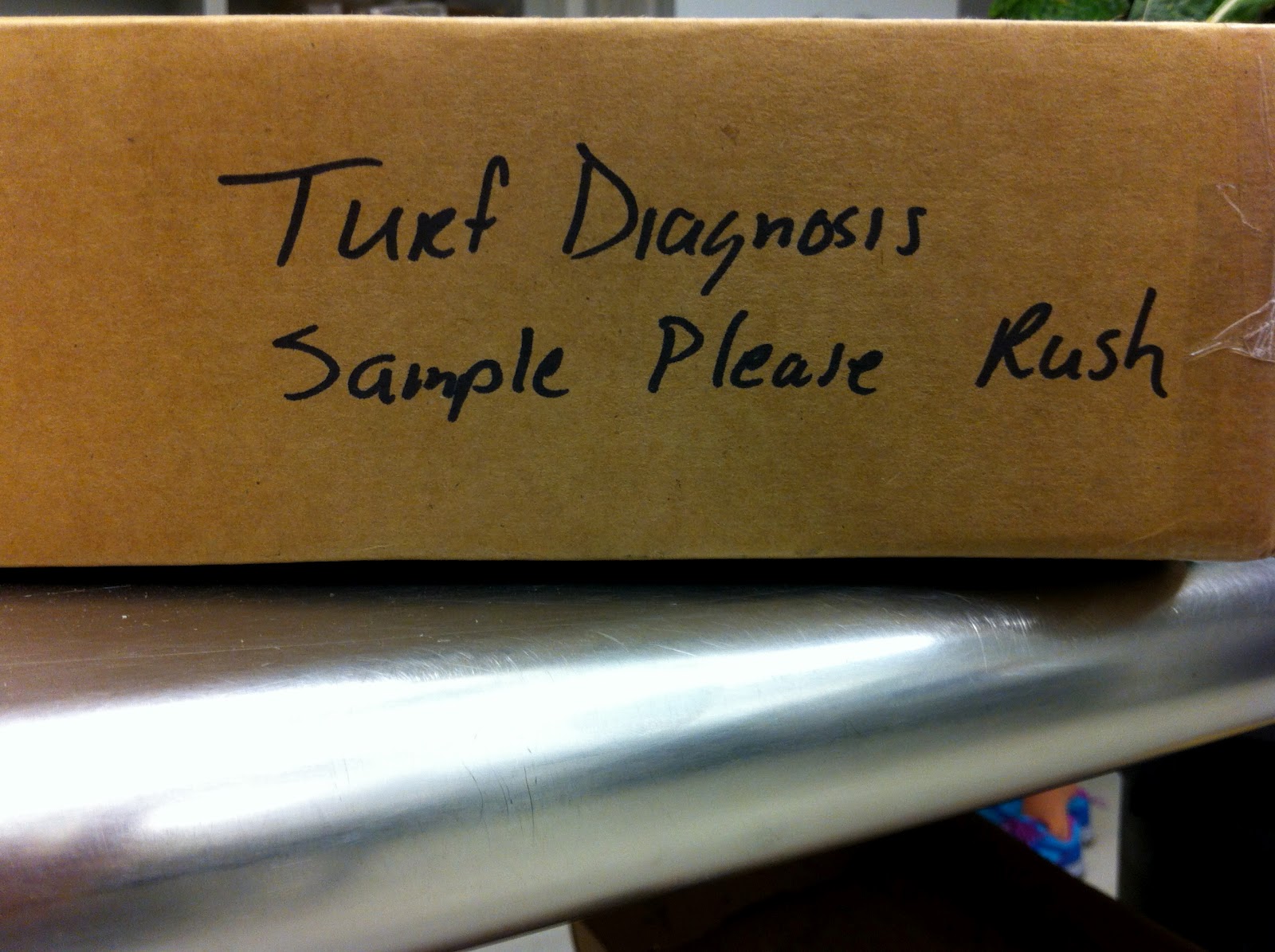
After a relatively quiet June at the NC State Turf Diagnostics Lab, turf samples have been rolling in during the month of July. Right after the record breaking heat wave experienced by North Carolina and much of the country, it seemed as if delivery trucks were backing up and dumping cardboard boxes of all shapes and sizes chocked full of ailing turfgrass samples.
One of the most common questions I get from golf course superintendents that I speak with on a weekly basis is "What are you seeing in the lab?" Well, here you go! Here's a rundown of the most common diagnoses we've made over the past two weeks.
Creeping Bentgrass Putting Greens
- Pythium root rot
- Fairy ring
- "Warm-weather" brown patch (Rhizoctonia zeae)
- Yellow spot
- Anthracnose
Home Lawns
Zoysiagrass
- Curvularia leaf spot
Bermudagrass
- Heat/drought stress
Tall Fescue
- Brown patch
Subscribe to:
Comments (Atom)