Showing posts with label Rhizoctonia. Show all posts

Tuesday, June 11, 2013

Guess What Now?? Brown Patch Blasting Tall Fescue in NC!


June is in full swing and so is brown patch in tall fescue lawns and landscapes.  Brown patch, caused by the fungus Rhizoctonia solani, is the most common disease in tall fescue during late spring and throughout the summer months in North Carolina.  Brown patch infections can start as early as April in some years with full blown outbreaks occurring by late May and early June in most years.  As the name implies, symptoms are brown to tan areas of turf that are roughly circular patches that range from a few inches to several feet in diameter.


Brown Patch Lesion on Tall Fescue Leaf

The two most common mistakes managers of tall fescue make are fertilizing too late or too much in late spring and over watering.  Tall fescue should not be fertilized after the first of May, unless you are using ultra low rates (< 0.25 lb N/M) with iron for a color effect.  The recommended amount of nitrogen on tall fescue per year is 3-4 pounds per 1,000 square feet.  Most people will apply a pound or two in the fall and a pound or two in the spring.  When in doubt, submit a soil test to ensure you're feeding your lawn the right nutrients at the correct amounts.

Watering should be done only as needed to prevent drought stress.  When you do apply irrigation, do it deep and infrequent instead of watering every day.  It is a common mistake for homeowners to set their irrigation system on a schedule and forget about it.  Remember, fungi love water and if you over water, you're giving the advantage to the fungi, not the turfgrass.  The ideal time to water your lawn is in the early morning hours before sunrise.  Irrigating during late afternoon or early evening is the worst thing you can do because this extends the leaf wetness period, however brown patch will love you for it!

Symptoms of Brown Patch in Tall Fescue

Need help knowing when and how much to water your lawn?  Try out our online water management tool at the following link.

http://turf-ims.ncsu.edu/

For more information about brown patch, including control recommendations, please visit the following link.

Monday, July 23, 2012

The Rundown


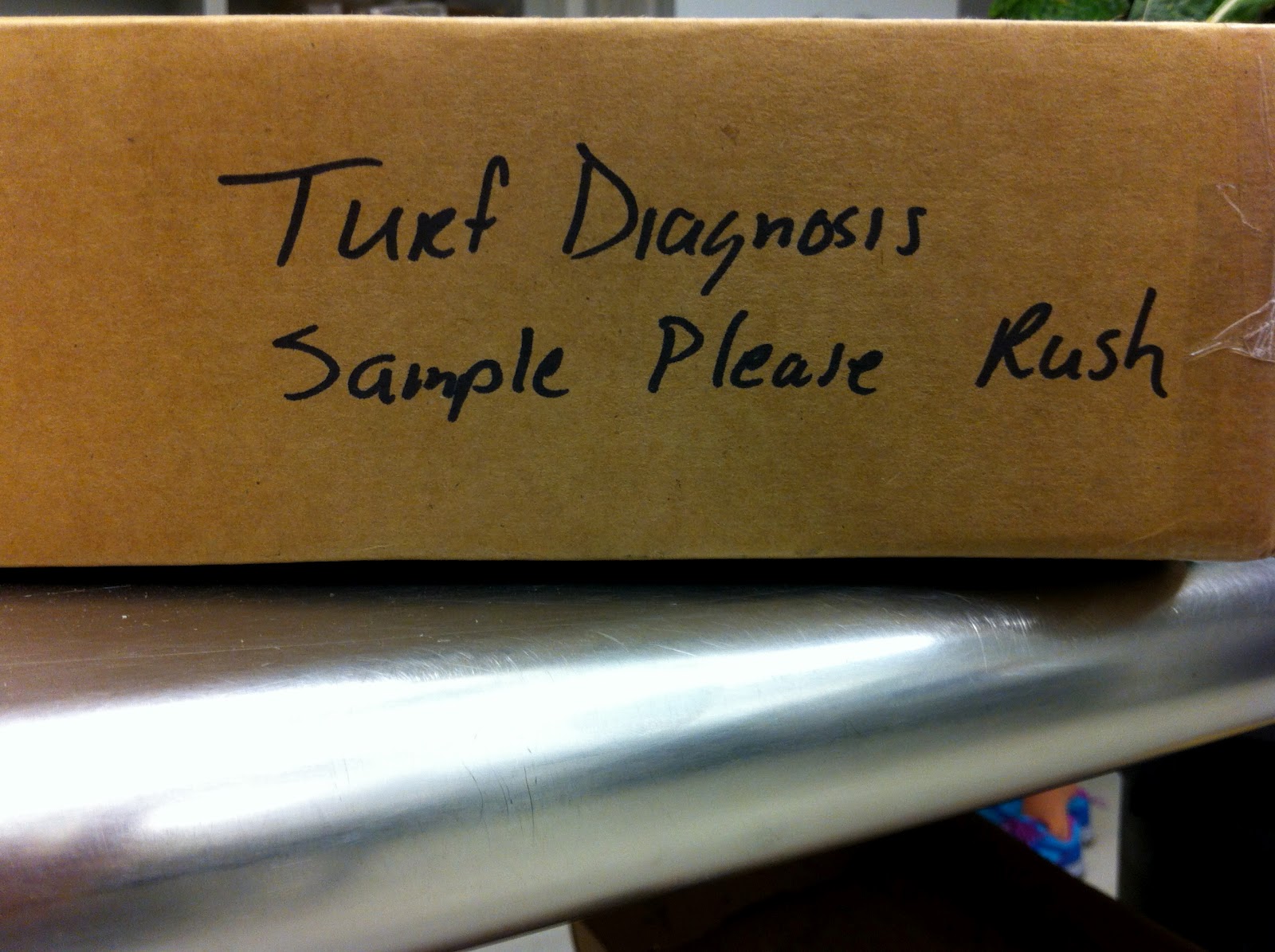
After a relatively quiet June at the NC State Turf Diagnostics Lab, turf samples have been rolling in during the month of July. Right after the record breaking heat wave experienced by North Carolina and much of the country, it seemed as if delivery trucks were backing up and dumping cardboard boxes of all shapes and sizes chocked full of ailing turfgrass samples.

One of the most common questions I get from golf course superintendents that I speak with on a weekly basis is "What are you seeing in the lab?" Well, here you go! Here's a rundown of the most common diagnoses we've made over the past two weeks.


Creeping Bentgrass Putting Greens
  1. Pythium root rot
  2. Fairy ring
  3. "Warm-weather" brown patch (Rhizoctonia zeae)
  4. Yellow spot
  5. Anthracnose

Home Lawns

Zoysiagrass
  1. Curvularia leaf spot
Bermudagrass
  1. Heat/drought stress
Tall Fescue
  1. Brown patch


Wednesday, June 20, 2012

Summer Solstice Welcomes Brown Patch

June is in full swing and so is brown patch in tall fescue lawns and landscapes.  Brown patch, caused by the fungus Rhizoctonia solani, is the most common disease in tall fescue during late spring and throughout the summer months in North Carolina.  Brown patch infections can start as early as April in some years with full blown outbreaks occurring by late May and early June in most years.  As the name implies, symptoms are brown to tan areas of turf that are roughly circular patches that range from a few inches to several feet in diameter.


Brown Patch Lesion on Tall Fescue Leaf


The two most common mistakes managers of tall fescue make are fertilizing too late or too much in late spring and over watering.  Tall fescue should not be fertilized after the first of May, unless you are using ultra low rates (< 0.25 lb N/M) with iron for a color effect.  The recommended amount of nitrogen on tall fescue per year is 3-4 pounds per 1,000 square feet.  Most people will apply a pound or two in the fall and a pound or two in the spring.  When in doubt, submit a soil test to ensure you're feeding your lawn the right nutrients at the correct amounts.

Watering should be done only as needed to prevent drought stress.  When you do apply irrigation, do it deep and infrequent instead of watering every day.  It is a common mistake for homeowners to set their irrigation system on a schedule and forget about it.  Remember, fungi love water and if you over water, you're giving the advantage to the fungi, not the turfgrass.  The ideal time to water your lawn is in the early morning hours before sunrise.  Irrigating during late afternoon or early evening is the worst thing you can do because this extends the leaf wetness period, however brown patch will love you for it!

Symptoms of Brown Patch in Tall Fescue

Need help knowing when and how much to water your lawn?  Try out our online water management tool at the following link.

http://turf-ims.ncsu.edu/

For more information about brown patch, including control recommendations, please visit the following link.


Wednesday, April 25, 2012

Severe Large Patch Outbreaks in NC


You know it's officially spring in North Carolina when there are giant patches of brown grass in bermudagrass, centipedegrass, St. Augustinegrass, and zoysiagrass. These giant patches of brown grass are better known as large patch, caused by the fungus Rhizoctonia solani, and if you've ever had an outbreak of this disease, you now know why the disease was coined large patch.

What you may not know however, is what your control options are this time of year. You shouldn't worry too much if you have this disease on bermudagrass. Bermudagrass tends to grow out of the damage once the temperatures are consistently warmer and the daylight longer.

As for our other warm-season friends, damage tends to be most severe on centipedegrass and recovery may take all summer in extreme cases. Unfortunately, there isn't much you can do to make for a magical recovery. We rarely recommend fungicides for large patch in the spring of the year, however in worst case scenarios, a fungicide application might help prevent the disease from spreading further. Fungicide applications are best when they are applied preventatively in the fall. If you choose to spray a fungicide this spring, don't expect a miracle to happen overnight. Also, remember that recovery will be even slower and tougher if you've applied a DNA type of herbicide as your pre-emerge for summer weeds.

In most cases, the best thing is to stay the course with management practices that will encourage each type of grass to do well. In severe cases, treating damaged areas like a new establishment with light and frequent fertilizer and water inputs may help encourage faster lateral spread. This doesn't mean you should apply more fertilizer, just smaller doses more often. Applying too much fertilizer will make the disease worse this fall!

Finally, be sure to map the affected areas now while they are clearly visible. You will save yourself some money this fall by spot treating these areas instead of having to make a whole property application, since the disease tends to reappear in the same areas.

For more information about large patch, click here.

For more information about warm-season grass maintenance, click here.

Wednesday, June 1, 2011

Brown Patch Alert

Brown patch has exploded on tall fescue landscapes and creeping bentgrass putting greens over the last week in the Piedmont of North Carolina. Warm night temperatures, high humidity, and rain have created ideal conditions for this disease to develop.

Looking at the weather forecast, conditions will remain favorable for brown patch for the foreseeable future. Creeping bentgrass putting greens and high-value tall fescue landscapes should be treated with preventive fungicides as soon as possible. If the disease is allowed to progress much longer, recovery will be very slow now that the summer heat has set in.

The QoI fungicides azoxystrobin (Heritage), fluoxastrobin (Disarm), pyraclostrobin (Insignia), and trifloxystrobin (Compass) are best for brown patch control and provide 21 to 28 days of protection against the disease. None of these products are readily available to homeowners, and the products you'll find on the shelves at home improvement stores are not very effective against brown patch. If you have a brown patch problem in your lawn or landscape, it's best to call a professional.

For more information about brown patch, please visit turfpathology.org.

Tuesday, April 12, 2011

Spring rings on MiniVerde greens


We don't have a whole lot of MiniVerde in North Carolina yet, but we've had several reports of widespread rings appearing on MiniVerde greens as they are greening up this spring. Interestingly, we haven't had similar reports from superintendents with Champion or Tifeagle greens.

The rings on MiniVerde are typically about 1 foot in diameter and are very irregular in shape, not perfectly circular. The turf on the outer edge has a yellow or reddish-brown cast to it.

Any time we see this type of spring symptom on warm-season grasses, we automatically think that it is large patch caused by Rhizoctonia solani. Based on our initial look at samples, it is definitely a Rhizoctonia disease, but we are isolating to confirm exactly which species is the culprit.

Either way, recovery should be very quick once sunlight and warm temperatures come and the bermudagrass starts growing aggressively. In fact, two superintendents reported that the symptoms have already become less noticeable as the bermudagrass continued to green up.

A fungicide application probably isn't necessary, but could help to speed up the recovery process if the symptoms are very severe or widespread. Any systemic Rhizoctonia fungicide, such as azoxystrobin, flutolanil, or fluoxastrobin should provide good control. Check out the Disease Management Utility for a complete list of products labeled for large patch control.

Monday, February 7, 2011

Watch out for yellow patch on putting greens and landscapes

Yellow patch on an annual bluegrass putting green
Given the cool, wet weather we've had over the last few weeks, golf course superintendents should be on the lookout for yellow patch in their creeping bentgrass putting greens. This disease is also known as 'cool-season brown patch', but the symptoms are very different. Yellow patch appears in irregular rings and arcs that are yellow, or sometimes white. Some people say it looks just like sweat rings on an old baseball cap.

Yellow patch can also occur in landscapes established with Kentucky bluegrass or tall fescue. In these cases, the rings are not so distinct but instead has a very irregular appearance. Distinct lesions that are white or light tan with a light brown border can be seen on the affected leaves.

Yellow patch in a Kentucky bluegrass landscape
Yellow patch can be controlled easily with fungicides, but recovery can be slow if the turf is not growing due to cool temperatures. Early detection and treatment is very important for this reason.

Refer to the Disease Management Utility on TurfFiles for a list of recommended fungicides for yellow patch control.